Austin is not an easy city to own a car in. The summer heat alone is enough to accelerate wear on components that would last years longer in a cooler climate. Add in the stop-and-go on MoPac and 183, the dust and limestone grit from the Hill Country, and the wide temperature swings between February mornings and August afternoons, and you have conditions that demand more from your maintenance schedule than the owner’s manual was written for.
At German Auto Center in Austin, TX, we have been servicing Audi vehicles in Central Texas since 1979. Over that time we have developed a clear picture of which maintenance items Austin Audi owners consistently skip and which ones tend to produce the most expensive repair visits when they are pushed too far. This guide covers both, organized by system, with realistic service intervals adjusted for what we actually see in our market.
Audi builds genuinely well-engineered cars. The EA888 2.0 TFSI, the S tronic dual-clutch gearbox, the quattro drivetrain, the ADAS sensor suite on newer models — these are sophisticated systems that reward attentive ownership. They also make it clear when they have been neglected, and the cost of catching up on deferred maintenance almost always exceeds the cost of staying ahead of it.
Engine Oil: The Maintenance Item Austin Heat Makes More Important
How often should I change the oil on my Audi in Austin?
Audi’s factory service interval for many EA888-equipped models stretches to 10,000 miles under the Audi dealer oil life monitoring system. In a cooler climate with predominantly highway driving, that interval is defensible. In Austin, we recommend shortening it.
Here is why. Heat degrades motor oil faster than mileage does. An Audi sitting in stop-and-go traffic on 35 in August with the air conditioning compressor cycling continuously is working hard under conditions the factory interval was not designed around. Oil viscosity breaks down faster under sustained heat, and contamination from combustion byproducts accumulates more quickly in short-trip, high-heat operating cycles. We see the difference in oil condition on cars that come in at 10,000 miles versus those that come in at 6,000 to 7,000 miles under Austin conditions.
On B8 A4s and A6s with Gen 1 and Gen 2 EA888 engines, shorter oil intervals also do meaningful preventive work on the timing chain tensioner. The tensioner relies on oil pressure to maintain chain tension, and worn or dirty oil reduces that pressure margin. Changing oil at 6,000 to 7,000 miles on these cars keeps the tensioner in better condition and extends chain life considerably.
Always use a VW/Audi-spec full synthetic oil meeting the 502.00 or 504.00 specification. Using the wrong oil spec on an Audi is not a minor issue. The EA888 tolerances are tight, and off-spec oil affects turbocharger lubrication, timing chain tensioner function, and, on the Gen 1 engine, the balance shaft assembly.
Check your oil level once a month, not just at service intervals. A B8 Audi with the Gen 1 EA888 can consume oil between changes, and running low between services causes more wear than the oil change interval itself.
Cooling System Maintenance: Where Austin Heat Creates Real Risk
Why does Austin heat affect my Audi’s cooling system more than in other cities?
The ambient temperature in Austin from May through September means your Audi’s cooling system is working at or near its design margin for months at a time. Components that are beginning to wear — the thermostat, the water pump, the expansion tank — give out faster under sustained heat load than they would in a milder climate.
The plastic expansion tank is a specific concern on EA888-equipped Audis. It is a pressurized component that cycles between hot and cold with every drive, and small stress cracks develop over time, particularly on cars that spend a lot of time in Austin’s summer temperatures. A cracked expansion tank can fail quickly once it starts leaking under pressure, and the result is rapid coolant loss that is easy to miss until the low coolant warning triggers or the temperature gauge starts moving.
The water pump on the Gen 1 EA888 uses a plastic impeller that can separate from the shaft on higher-mileage cars. When it fails, coolant stops circulating while the pump appears to run normally because the shaft is still turning. The engine overheats despite normal coolant level and no visible leaks. We recommend inspecting the impeller condition on any B8 Audi with over 70,000 miles, and replacing the pump proactively if the impeller shows any degradation.
We recommend pressure testing the cooling system and checking coolant condition every two to three years on any Audi driven primarily in Central Texas. The thermostat should be replaced at the first sign of inconsistent temperature gauge behavior or slow cabin heat warm-up. A thermostat replacement is a modest cost. The head gasket repair that follows an overheating event is not.
Brake System Maintenance in a City Built on Inclines
How does Austin driving affect Audi brake wear?
Austin’s topography is more varied than it appears. The Hill Country routes to the west, the grades on 360, the constant deceleration of city driving — these wear brake pads and rotors faster than flat, steady-speed highway driving. Audi’s sport-tuned brake bias also means the front brakes do more of the work, and front pad life on an Audi driven aggressively in the city is shorter than most owners expect.
The Audi brake pad wear sensor alerts you when the front pads reach minimum thickness and should be replaced within the next 2,000 to 3,000 miles. Take this alert seriously. Driving beyond minimum pad thickness on an Audi damages the rotors, and Audi rotors are not inexpensive. On the rear brakes, most A4 and A6 configurations do not have wear sensors. The sign that rear pads are getting thin is a light metallic scraping sound during gentle braking that disappears under harder stops. If you hear this, have the rear pads inspected before the next scheduled service.
Brake fluid is a maintenance item many Audi owners overlook because they cannot see it degrading. Brake fluid is hygroscopic, meaning it absorbs moisture from the atmosphere over time. As moisture content increases, the fluid’s boiling point drops. In Austin’s summer heat, particularly on Hill Country drives with repeated braking on descents, degraded brake fluid can boil under hard use and cause a momentary loss of pedal firmness. We recommend changing brake fluid every two years on Audis driven in Central Texas, regardless of mileage.
When the front rotors and pads are being replaced, it is a practical time to flush and replace the brake fluid as well. Everything is already accessible, the time added is minimal, and it ensures you are starting a new set of pads with fresh fluid.
S Tronic and DSG Transmission Service: Do Not Skip This in Texas Heat
How often should the S tronic or DSG fluid be changed on an Austin Audi?
The dual-clutch S tronic transmission in most Audi A4, A5, and A6 models was originally marketed as a sealed-for-life unit requiring no fluid maintenance. This claim has not held up in the field, and most independent Audi specialists now recommend fluid service every 40,000 miles under normal driving conditions.
Austin conditions push that interval earlier. Stop-and-go traffic is particularly hard on a dual-clutch gearbox because the clutch packs are constantly engaging and disengaging at low speeds rather than operating primarily at higher speeds as they were designed to. Heat accumulates in the transmission fluid during sustained urban driving, and degraded S tronic fluid produces the shudder, hesitation, and rough low-speed engagement that owners often mistake for a mechanical fault. In many cases, a fluid service resolves these symptoms entirely.
The mechatronic unit inside the S tronic is a hydraulic control assembly that wears progressively with contaminated fluid. A fluid service at the right interval protects the mechatronic. Replacing a worn mechatronic unit is an expensive repair that is almost always traceable to extended fluid intervals. We see this pattern regularly on Austin Audis that have been maintained on the factory dealer schedule.
If your Audi has a CVT transmission rather than the S tronic, the maintenance logic is similar. The CVT belt and pulley assembly is sensitive to fluid condition, and heat accelerates fluid degradation. A CVT fluid service every 30,000 to 40,000 miles is appropriate for Central Texas driving.
Uriel Gallardo brought his Audi in after noticing shifting behavior he had not experienced before. He described the experience afterward: “They walked me through everything, kept me updated, and the car drives like new again.” A transmission fluid service was the primary repair. He had not known the S tronic needed fluid maintenance at all — it simply was not on his radar from the dealer service history.
Steering and Suspension: What Austin Roads Do to Audi Components
Do Austin roads cause more suspension wear on Audis?
Yes, and it is not subtle. Austin’s road surface quality varies considerably, and the expansion joints, rough patches, and occasional pothole on city streets create impact loads that accelerate bushing wear on any vehicle with a precision suspension setup. Audi’s multilink rear suspension uses tight-tolerance bushings that deliver excellent handling, and those bushings wear measurably faster on Austin roads than on smooth highway driving.
The front lower control arm bushings are the most frequent suspension wear item we replace on Austin Audis. When they begin to fail, the symptom is a knocking or clunking sound over rough pavement, particularly when the suspension compresses over bumps or expansion joints. The steering can also feel slightly vague or imprecise at highway speeds when control arm bushings are worn. Left alone, worn control arm bushings allow the alignment to shift out of spec, which causes uneven tire wear on top of the NVH issues.
Wheel bearings are worth knowing about on higher-mileage Audis. A failing wheel bearing produces a hum that changes tone with vehicle speed and often changes character when weight shifts during a lane change. The sound typically starts at 25 to 35 mph as a low hum and becomes more pronounced at higher speeds. Wheel bearing failure on an Audi should not be ignored — a worn bearing that fails completely affects steering control.
We also see power steering system issues on older hydraulic-assist Audi models in Austin. The heat accelerates power steering fluid degradation, and we recommend flushing and replacing the fluid every 30,000 miles on any Audi with hydraulic power steering. On electric power steering systems, which most current Audi models use, there is no fluid to maintain, but the system’s software calibration and sensor accuracy are worth verifying during alignment checks.
Tires and Alignment: The Maintenance Pairing That Protects Both
How often should I get an alignment check on my Audi in Austin?
Once a year is the right cadence for an Austin Audi. Austin roads introduce alignment-disrupting impacts more regularly than highway-only driving would, and alignment drift happens gradually enough that it is easy to miss until uneven tire wear makes it visible. By then, the tires have already paid the cost of the misalignment.
Audi’s quattro all-wheel drive system is particularly sensitive to tire condition. The Haldex or Torsen center differential — depending on the model — operates on the assumption that all four tires have nearly identical rolling circumference. Worn tires mixed with new tires, or tires that are significantly different in diameter from side to side, can cause the AWD system to work harder than it should and produce driveline wear over time. Rotating tires on schedule and replacing tires in axle pairs at minimum is standard practice on any quattro-equipped Audi.
Austin’s summer heat also accelerates tire compound hardening on cars that sit outdoors regularly. Tires that look fine visually but have been exposed to extended UV and heat cycles may have lost meaningful grip and compliance. Age matters as much as tread depth on a tire, and we recommend replacing any Audi tire that is six or more years old regardless of remaining tread.
Battery and Electrical Maintenance: What Austin Summer Does to a 12-Volt Battery
Why do car batteries fail faster in Austin?
Heat is harder on automotive batteries than cold is. The conventional wisdom about cold weather killing batteries is true, but it misses the underlying cause — batteries that are weakened by summer heat are the ones that fail to start on cold mornings. Austin’s summer temperatures accelerate the internal degradation of a lead-acid battery faster than northern climates do, and we see a higher frequency of battery-related electrical faults on Austin vehicles than the mileage alone would predict.
On modern Audis, a weakening battery does not always present as a failure to start. It presents as multiple unrelated warning lights appearing simultaneously, MMI system resets, transmission hesitation codes, and suspension fault messages that clear themselves and return. The integrated electronics architecture shares voltage across all of these systems, and unstable voltage from a degraded battery triggers faults across unrelated modules. Replacing the battery resolves all of them at once — but only if the battery replacement is accompanied by the registration procedure that tells the charging system it is working with a new battery. This step requires Audi-compatible software and is skipped at many shops that replace the battery without performing it.
We recommend testing battery condition annually on any Audi that is more than three years old. A battery test takes a few minutes and catches degrading batteries before they produce the cascading electrical faults that are harder to diagnose after the fact.
Jim Rado, one of our customers, summed up what he looks for in a shop simply: “Car was taken care of to the minutest detail.” That is exactly the standard we try to hold ourselves to on every service visit, whether it is an oil change or a full diagnostic. Maintenance is only useful when it is done correctly, and the detail work matters on a German car.
A Practical Audi Service Schedule for Austin Driving Conditions
The intervals below are adjusted for Central Texas conditions. They are more conservative than Audi’s factory schedule in some areas, and we make no apology for that. The factory schedule was not written for 100-degree summers and Austin stop-and-go traffic.
Every 6,000 to 7,000 miles: Oil and filter change using VW/Audi-spec full synthetic. Oil level check monthly between services.
Every 15,000 to 20,000 miles: Cabin air filter replacement. More frequently if the car is parked outdoors or driven on dusty Hill Country roads.
Every 20,000 to 30,000 miles: Engine air filter inspection and replacement as needed. Tire rotation. Brake fluid condition check.
Every 2 years regardless of mileage: Brake fluid replacement. Coolant condition check and pressure test. Battery condition test on cars over 3 years old.
Every 40,000 miles: S tronic or DSG transmission fluid service. Spark plug inspection and replacement as needed on EA888 engines.
Every 60,000 miles: Suspension bushing inspection. Wheel bearing check. Full alignment verification. Water pump inspection on B8 cars with Gen 1 EA888.
As needed based on symptoms: Carbon cleaning (intake walnut blast) on direct injection EA888 engines typically required between 50,000 and 80,000 miles. Power steering fluid flush on hydraulic systems. Drive belt inspection.
Why Austin Audi Owners Choose an Independent Shop for Scheduled Maintenance
Scheduled maintenance at an Audi dealer in Austin is expensive. More importantly, it tends to follow the factory service schedule without adjustment for local conditions, which means some items get pushed longer than makes sense for Central Texas driving. An Austin Audi Repair Shop that specializes in German vehicles and knows this market can build a maintenance plan around how the car actually gets used — not just how Audi’s service marketing says it should be used.
The equipment side matters here. Audi maintenance is not generic work. Reading live data from an EA888 engine, registering a new battery, clearing adaptation values after a transmission fluid service — these procedures require VCDS-compatible or manufacturer-equivalent diagnostic software. A shop performing Audi maintenance without that equipment is doing an incomplete job regardless of how skilled the technician is.
We are a Bosch Authorized Service Center with ASE-certified technicians and over 45 years working on German vehicles in Austin. We use Audi-compatible diagnostic tools on every car and we stock Bosch-supplied OEM components. The work is done right the first time, and we tell you exactly what we are doing and why.
Damon Osgood, who has been bringing his car to us for years, described what keeps him coming back: “This shop is consistently excellent in terms of customer service and professionalism. They are honest and trustworthy, the kind of place you build a long term relationship with.” That is what a maintenance relationship should be. You should know your shop and your shop should know your car.
Frequently Asked Questions
How often should I change the oil on my Audi in Austin?
+
We recommend every 6,000 to 7,000 miles for Audis driven primarily in Austin under normal conditions. The factory 10,000-mile interval was not developed for sustained summer heat and stop-and-go urban driving. Shorter intervals extend timing chain tensioner life on B8 cars and reduce thermal degradation of the oil between services.
Does the Audi S tronic transmission really need fluid service?+
Yes. Despite the original sealed-for-life claim, S tronic transmission fluid degrades with use and heat. We see the shudder, hesitation, and rough low-speed engagement symptoms that come from extended fluid intervals regularly on Austin Audis. A fluid service every 40,000 miles resolves these symptoms in many cases and protects the mechatronic unit from the wear that leads to expensive repairs.
How does Austin heat affect my Audi’s cooling system?+
Austin’s summer temperatures mean the cooling system operates near its design margin for months at a time. This accelerates wear on the thermostat, the expansion tank, and on B8 cars the plastic water pump impeller. We recommend a cooling system pressure test every two to three years and proactive water pump inspection at 70,000 miles on any Gen 1 or Gen 2 EA888 engine.
How often should I get an alignment on my Audi in Austin?+
Once per year is the right interval for Austin conditions. The road surface quality and frequency of impact events here disrupts alignment more regularly than highway driving would. Uneven tire wear is usually the first visible sign that alignment has drifted, but by then the tires have already absorbed the cost of the misalignment. Annual checks catch the issue before it shows up in the tires.
Where can I find an Audi Repair Shop in Austin that knows Audi-specific maintenance?+
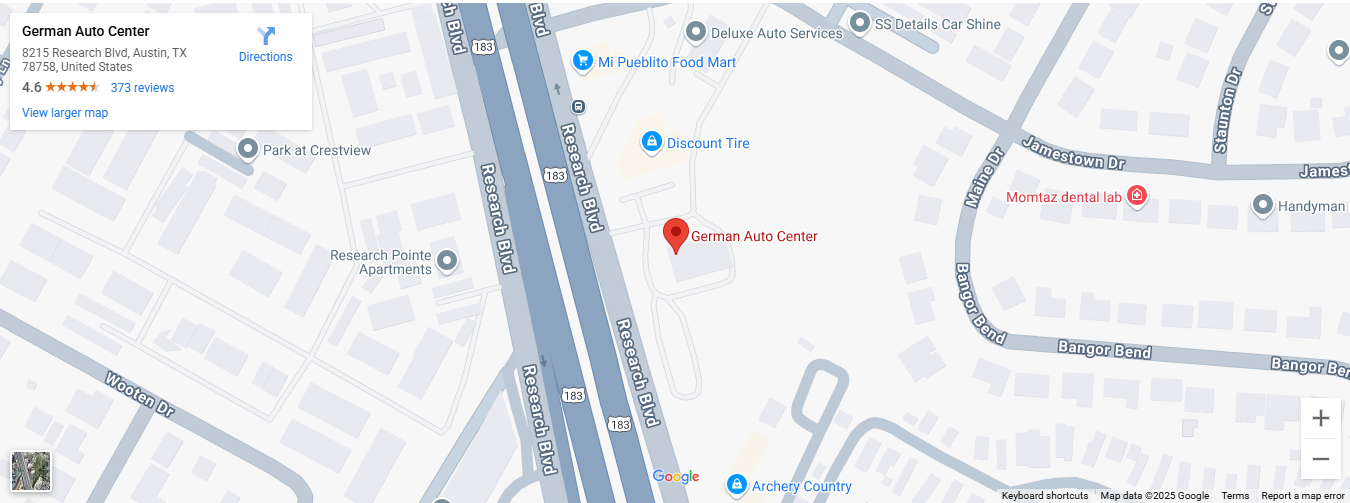
German Auto Center at 8215 Research Blvd, Austin TX 78758. We are a Bosch Authorized Service Center with over 45 years of experience on German vehicles. We service all Audi models including the A3, A4, A5, A6, Q5, Q7, and TT. Call (512) 452-6437 or schedule online at germanautocenter.com.
Should I use the dealership or an independent shop for Audi maintenance in Austin?
+
An independent shop with the right equipment and Audi-specific expertise provides equivalent work quality at 30 to 40 percent lower labor cost than a dealership. The key requirements are VCDS-compatible or manufacturer-equivalent diagnostic software, technicians trained on German vehicle systems, and OEM-quality parts sourcing. German Auto Center meets all three and is a Bosch Authorized Service Center.
If you want to build a maintenance plan for your Audi that accounts for how you actually drive in Austin, give us a call at (512) 452-6437 or schedule online. Bring it to 8215 Research Blvd and we will run through the car’s service history, tell you what is due and what can wait, and give you an honest picture of where things stand. No upsell, no pressure.