A used BMW at the right price looks like one of the better deals in the car market. Strong engines, well-sorted driving dynamics, and a level of engineering sophistication you won’t find in most other vehicles at the same price point. But that sophistication cuts both ways. When a BMW is well maintained, it’s an exceptional car. When it isn’t, the repair costs can climb fast.
At German Auto Center, we’ve been servicing BMWs in Austin since 1979. Over those 45 years we’ve seen every generation of 3-series, 5-series, X5, and more come through our shop. We know which ones hold up well, which ones have known failure patterns, and what to look for before you hand over your money.
This guide covers the specific things that matter on a used BMW purchase in Austin — not generic used car advice, but the BMW-specific checks that separate a solid buy from an expensive mistake.
Why Buying a Used BMW Requires a Different Approach
BMWs are engineered to a standard that most other cars aren’t. The engines are more complex, the electronics more sophisticated, and the maintenance intervals more precise. That’s what makes them exceptional to drive. It’s also what makes deferred maintenance so costly down the road.
Most BMW problems we see on used cars aren’t design failures. They’re maintenance failures. An N54 engine with a documented oil change history every 5,000 miles is a fundamentally different car from the same engine that went 12,000 or 15,000 miles between changes because the owner followed the CBS system without question. Same engine. Very different condition.
Austin’s climate adds to this. Long, hot summers put additional stress on cooling systems, rubber components, and electrical connections. A BMW that spent its first five years in a more moderate climate and then moved to Central Texas is going to show different wear patterns than one that’s lived here its whole life. It’s worth asking where the car was registered before you bought it.
Service History: The Most Important Document in the Deal
Ask for service records before you do anything else. On a BMW, the service history tells you more about the car’s actual condition than the inspection will. It tells you how often the oil was changed, whether cooling system service was performed, whether there’s a pattern of deferred maintenance, and whether the car spent time at a dealership, an independent shop, or nowhere at all.
The ideal is complete records from a single shop or dealership, with consistent oil changes every 5,000-7,000 miles. The reality on many used BMWs is spotty records, long service intervals, and a seller who says “it was always maintained” without anything to back it up. Treat undocumented maintenance history as no maintenance history. Price the car accordingly.
One thing to watch for specifically: the BMW Condition Based Service (CBS) system monitors oil life electronically and can allow intervals of 10,000-15,000 miles or more. Some owners follow that interval without question. In our experience, engines maintained at those extended intervals show measurably more wear than ones serviced every 5,000-7,000 miles. Extended oil life doesn’t mean extended engine life.
Dennis Dalton moved to Austin from Dallas with a drivetrain issue on his 7-series. After we completed the diagnosis and repair, he told us the team “went above and beyond to take a look at the entire car and let me know what may be an issue down the road, without any pressure at all to get it done that day.” That’s what a proper inspection looks like. It starts before you buy, not after.
Which Generation Are You Actually Buying?
BMW reuses model names across generations that are very different cars. A 2008 E90 328i and a 2014 F30 328i are not the same vehicle. They have different engines, different electrical architectures, and different known failure patterns. Knowing the chassis code matters when you’re evaluating a used BMW.
3-Series: E90/E92 (2006-2013) vs. F30 (2012-2019)
E90 and E92 cars with the N52 naturally aspirated engine are generally reliable workhorses. The N54 turbocharged engine in the same generation is more powerful and more maintenance-sensitive. High-pressure fuel pump failure is a known N54 issue, as is wastegate rattle, valve cover gasket leaks, and charge pipe failure. These aren’t reasons to avoid an N54 — they’re items to check and factor into your offer.
F30 cars with the N20 four-cylinder are capable and efficient but have a documented timing chain tensioner issue on early production models (roughly 2012-2015). This is a well-known problem that BMW addressed in production, but earlier examples that haven’t had the updated tensioner are worth scrutinizing. We check this on every N20 that comes in for a PPI.
5-Series: E60 (2004-2010) vs. F10 (2011-2016)
The E60 with the V8 N62 engine has a notorious valley pan gasket issue that requires significant labor to address — the intake manifold has to come off to access it. Not a reason to walk away, but a known cost to factor in. The N62 is otherwise a strong engine when maintained.
F10 5-series cars are generally more reliable but still benefit from thorough inspection of the cooling system, oil filter housing gasket (a common leak point on the N52 and N20 engines), and transmission fluid condition. The 8-speed ZF automatic in F10 cars is excellent when serviced; skipped fluid changes shorten its life significantly.
X5: E70 (2007-2013) vs. F15 (2014-2018)
The E70 X5 is one of the most common BMWs we see in Austin. Strong, capable truck — and one that has specific maintenance requirements that get missed on high-mileage examples. Transfer case fluid, rear differential fluid, and power steering fluid are items that many owners skip. We find neglected transfer cases regularly on high-mileage E70s, and the repair is not cheap.
F15 X5s are cleaner mechanically in most respects. The B58 engine in later examples is one of BMW’s better modern units. Still worth checking the oil filter housing gasket and verifying transfer case and differential service history.
Cooling System: A Known BMW Weakness Worth Taking Seriously
BMW cooling systems have a documented tendency to develop problems as cars age, and it’s one of the areas where deferred maintenance has the most consequences. The water pump, thermostat, expansion tank, and associated hoses are all plastic or rubber components that degrade over time. On E90 and E60 generation cars, cooling system failure is one of the most common repairs we perform.
On a test drive, watch the temperature gauge. It should come up to operating temperature within a few minutes and hold steady throughout the drive. If it runs hotter than normal, fluctuates, or climbs above the midpoint on a highway run, the cooling system needs attention before you commit to the car.
Also check the expansion tank carefully. On many E-series BMWs, the plastic expansion tank develops small cracks that can cause slow coolant loss and intermittent overheating. It’s an inexpensive part. The consequences of ignoring it are not inexpensive.
In Austin’s heat, a marginal cooling system that might limp along in a cooler climate will fail faster. We see more cooling-related failures here in the summer months than at any other time of year, and most of them were preventable.
Electrical Systems: What to Check and What to Watch For
BMW electrical systems are sophisticated and, when everything works, genuinely impressive. When they don’t, diagnosis requires proper BMW-specific equipment and a technician who understands the architecture. Not every independent shop is equipped for this.
Before buying any used BMW, check every electrical function you can access: windows, mirrors, sunroof, iDrive system, all climate controls, heated seats, parking sensors, and adaptive headlights if equipped. Issues that seem minor — a sticky window switch, an intermittent iDrive fault — can indicate broader electrical problems or prior water intrusion.
Water damage is a specific concern on used BMWs. The most common entry points are the sunroof drains and the windshield seal. Check the carpet under the front floor mats and in the trunk for any signs of dampness or water staining. Electrical failures caused by water intrusion can be difficult and expensive to trace, and they’re often not disclosed by private party sellers.
We also recommend a full diagnostic scan before purchase. BMW’s fault memory retains codes even after they’ve been cleared, and a scan with proper BMW-compatible equipment can surface issues a seller tried to hide or simply didn’t know about.
Leaks, Noises and What They Actually Mean on a Used BMW
Oil leaks are common on higher-mileage BMWs, and not all of them are equal. A seeping valve cover gasket is a minor repair. A leaking oil filter housing gasket is moderate. A leaking rear main seal requires significant labor. When you look under a used BMW, you want to know where a leak is coming from before deciding how to price it. This is one of the reasons a proper BMW repair in Austin, TX inspection matters. It’s not just about spotting a leak. It’s about knowing what the leak means.
On the test drive, listen carefully. A well-maintained BMW should idle smoothly and quietly. Rough idle on a turbocharged engine can indicate coil pack issues, carbon buildup on direct injection models, or boost leaks. A clunking sound from the front suspension under load typically points to worn control arm bushings or thrust arm bushings, which are a known wear item on E90 and E60 generation cars.
Transmission behavior matters too. The automatic should shift smoothly through all gears without hesitation or hard engagement. A slight delay when selecting Drive from Park, or a shudder during light throttle acceleration, can indicate a transmission in need of service or a more serious issue.
None of these are necessarily deal-breakers. They’re information. A used BMW with a few known issues at the right price can be an excellent buy. The goal of the inspection is to know exactly what you’re buying before the transaction is complete, not to find a perfect car that doesn’t exist.
Why a Pre-Purchase Inspection Is Non-Negotiable on a Used BMW
A visual inspection and test drive will tell you a lot. It won’t tell you whether the N54’s high-pressure fuel pump is showing early wear, whether the N20’s timing chain tensioner has been updated, or whether the transfer case fluid has ever been changed. Those require proper diagnostic equipment and a lift.
At German Auto Center, our BMW pre-purchase inspection covers the full drivetrain, cooling system, suspension, brakes, electrical systems via ISTA-compatible diagnostic scan, body and structural condition, and fluid condition throughout. It takes about two hours. It costs $150-$250 depending on the model and what we find.
We’ve had customers come in after another shop quoted significant repair costs only for us to find the car was in far better shape than they were told. The reverse happens too. Either way, you leave knowing exactly what you’re buying.
Uriel Gallardo brought his BMW to us for brake service and told us the team “walked me through everything, kept me updated, and the car drives like new again. Pricing was fair, service was professional, and the quality speaks for itself.” That’s the standard we hold ourselves to on every inspection and every repair.
Buying a Used BMW in Austin: What the Local Market Adds to the Equation
Austin has a strong used BMW market. The tech industry brings in buyers who want a premium driving experience, and the resale market reflects that. Prices here tend to run slightly higher than national averages for clean examples, which means there’s less room to absorb surprise repair costs after purchase.
The climate factor is real. A BMW that’s lived in Austin its whole life has dealt with sustained heat, UV exposure, and the particular wear patterns that come with MoPac and IH-35 stop-and-go traffic. Rubber components age faster here. Cooling systems work harder. Air conditioning runs almost year-round, which means the compressor and associated components have more hours on them than the mileage might suggest.
None of that makes a local BMW a bad buy. It makes the inspection more important. Know what the car has been through before you commit to it.
Frequently Asked Questions
What should I check when buying a used BMW?
+
The most important items are service history and documentation, cooling system condition, electrical system function, oil leak sources and severity, transmission behavior, and a full diagnostic scan for stored fault codes. For turbocharged models, also check the high-pressure fuel pump, charge pipes, and boost system integrity. A professional pre-purchase inspection covers all of these systematically.
What are the most common problems on used BMWs?+
Cooling system failures (water pump, thermostat, expansion tank) are among the most common on E-series cars. N54 owners commonly deal with high-pressure fuel pump issues, valve cover gasket leaks, and wastegate rattle. N20 engines have a documented timing chain tensioner issue on early examples. E70 X5s frequently show neglected transfer case and differential fluids. Electrical issues, particularly on cars with water intrusion history, are also common across generations.
How much does BMW repair cost at an independent shop vs. the dealership in Austin?+
Independent shop rates in Austin typically run 30-40% lower than BMW dealership rates for the same work. On major jobs like cooling system overhauls, timing chain repairs, or suspension work, the savings can be significant. German Auto Center is a Bosch Authorized Service Center, which means the quality of parts and service matches what you’d get at the dealership, at a fraction of the overhead.
Should I get a pre-purchase inspection on a used BMW?+
Yes, without exception. A used BMW can look and drive perfectly well during a test drive while carrying issues that will cost thousands to repair. A proper pre-purchase inspection with BMW-compatible diagnostic equipment surfaces fault codes, identifies leaks, assesses wear, and gives you a complete picture of the car’s condition before you commit.
How often should a used BMW be serviced?+
We recommend oil changes every 5,000-7,000 miles regardless of what the CBS system indicates. Coolant service every 4 years or 50,000 miles. Brake fluid every 2 years. Transfer case and differential fluids every 30,000-40,000 miles on X-series cars. Transmission fluid at 60,000-mile intervals on automatics, even on models where BMW calls it a lifetime fill.
Can German Auto Center inspect a used BMW before I buy it?+
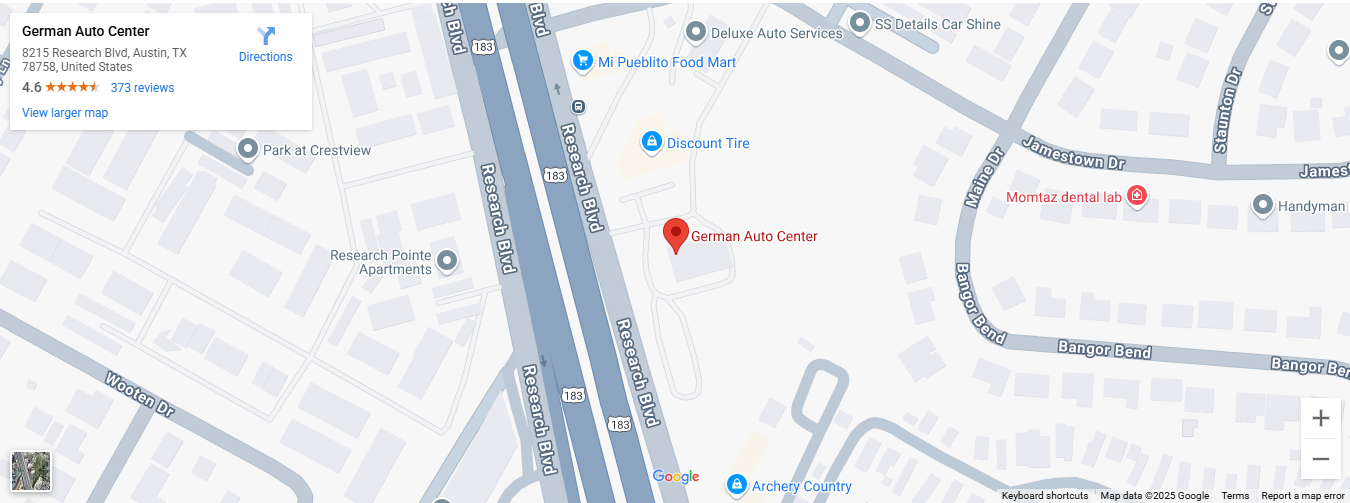
Yes. Bring the car to our shop at 8215 Research Blvd before you sign anything. If the seller is local, we can usually accommodate a same-day or next-day inspection. Call us at (512) 452-6437 to schedule.
If you’re seriously looking at a used BMW in Austin and want a straight picture of what you’re buying, give us a call at (512) 452-6437 or schedule online. Bring the car to 8215 Research Blvd before you commit. We’ll walk you through exactly what we find and give you an honest assessment of what it needs. No pressure, no upsell.