Your BMW’s dashboard just lit up on MoPac. Or you noticed a small puddle under the car this morning. Or something in the engine bay sounds slightly different than it did a month ago. You’re not sure whether it’s urgent or whether it can wait until the weekend.
These are the calls we get every week at German Auto Center. And the honest answer is that it depends entirely on which warning sign you’re dealing with. Some can wait a few days. Some can’t. Some that look minor are pointing at something expensive underneath. Others that look alarming are routine.
We service BMW models from 2018 and newer — the G-series 3-series and 5-series, G01/G05 X3 and X5, the M3 and M4 with the S58, and the full range of current-generation BMWs. The B48, B58, and S58 engines that power these cars are genuinely excellent. But they have their own warning signs and failure patterns that every Austin owner should understand.
This guide goes through the most common symptoms we see in the shop, what’s usually behind them, and what you should actually do when they show up.
What the Check Engine Light Means on a 2018+ BMW
The check engine light is the most misread warning in automotive ownership. Some drivers panic. Others tape over it and hope for the best. Neither is the right approach.
On 2018 and newer BMWs, the check engine light can be triggered by anything from a loose fuel cap to a failing high-pressure fuel pump to a misfiring cylinder. The light itself tells you nothing. What tells you something is the fault code stored in the engine control module, and reading that code properly requires BMW-compatible diagnostic equipment, not a generic OBDII scanner from a parts store.
Generic scanners read generic codes. BMW’s DME (Digital Motor Electronics) stores manufacturer-specific codes that a generic tool won’t surface. We’ve had customers come in who were told by a parts store that they had a simple oxygen sensor issue, only for our diagnostic to reveal a lean condition caused by an injector fault on the B48 — a meaningfully different and more expensive problem.
The rule we give every BMW owner: don’t ignore a check engine light for more than a few days, and don’t trust a diagnosis that came from a non-BMW scanner. If the light is flashing rather than steady, that indicates an active misfire and the car should not be driven hard until it’s been diagnosed. A flashing CEL is not the same as a steady one.
Higher Than Expected Oil Consumption: Normal Range vs. a Real Problem
What’s Normal on a B48 and B58?
BMW specifies that up to one quart of oil consumption per 750 miles is within acceptable limits on their turbocharged engines. Most owners find that range alarming, and frankly, it is on the higher end compared to other manufacturers. But it’s the reality of a high-performance turbocharged engine with tight tolerances running at elevated temperatures.
In practice, a well-maintained 2018+ BMW B48 or B58 in normal driving should consume far less than that. If you’re checking your oil between changes and the level is consistently dropping more than half a quart per 1,000 miles, that’s worth investigating rather than just topping off.
What Causes Excessive Oil Consumption on 2018+ BMWs?
The most common culprits we find on G-series BMWs are valve stem seal wear, piston ring wear on higher-mileage examples, and crankcase ventilation system issues. On the B48 specifically, the positive crankcase ventilation (PCV) system can develop leaks or blockages that push oil vapor into the intake, increasing consumption and eventually causing carbon buildup on the intake valves.
Carbon buildup on direct injection engines is a separate but related concern. Because port injection doesn’t wash the intake valves with fuel the way older engines did, carbon deposits accumulate over time. On the B48 and B58, this typically becomes noticeable around 60,000-80,000 miles and shows up as rough idle, hesitation under light throttle, and slightly elevated oil consumption. The fix is walnut blasting — a shop-only procedure that cleans the valves without disassembly.
If you’re adding oil between changes and your BMW is under 60,000 miles, don’t assume it’s normal. Bring it in. The earlier a consumption issue is caught, the less expensive it is to address.
Coolant Warning or Rising Temperature Gauge: Don’t Wait on This One
Cooling system warnings on a BMW demand immediate attention. This is not a wait-and-see situation. An overheating B58 or S58 engine can suffer head gasket damage, warped cylinder heads, or worse in a short amount of time. The cost of cooling system repair is a fraction of the cost of an engine that’s been heat-damaged.
What Sets Off Cooling System Warnings on 2018+ BMWs?
On current-generation BMWs, the most common cooling system issues we see are expansion tank failure, water pump wear, and thermostat malfunction. The G-series cars use an electric water pump that can fail without much warning — unlike a belt-driven pump that often makes noise before it goes. When the electric pump fails, coolant circulation stops and the temperature climbs quickly.
The expansion tank on 2018+ BMWs is still a plastic component, and while the material quality has improved over earlier generations, it remains a wear item. Small cracks can develop over time, causing slow coolant loss that’s easy to miss until the low coolant warning triggers or the temperature gauge starts climbing.
Austin’s heat accelerates all of this. A cooling system that’s marginal in a moderate climate will fail faster here. We recommend having the coolant condition checked every three years on 2018+ BMWs regardless of mileage, and the full system pressure-tested at the same interval. Catching a slow leak early is a very inexpensive repair compared to what follows if it’s ignored.
Oil Leaks on 2018+ BMWs: Where They Start and What They Cost
Finding oil on your garage floor under a 2018 or newer BMW is frustrating, especially on a car that’s not old. But oil leaks on current-generation BMWs are more common than most owners expect, and they almost always start in the same places.
Oil Filter Housing Gasket
This is the most common oil leak we see on B48 and B58 engines. The oil filter housing sits prominently on the front of the engine, and the gasket that seals it to the block is a rubber component that degrades with heat cycling over time. On a car that lives in Austin’s climate, this gasket works harder than it would in a cooler environment.
The leak typically presents as a slow seep that coats the underside of the engine over time. Left unaddressed, it can drip onto exhaust components and create a burning oil smell. The repair is moderate — a few hundred dollars at an independent shop — and straightforward when caught early.
Valve Cover Gasket
Valve cover gasket leaks are less common on 2018+ cars than on earlier generations, but they still show up on higher-mileage examples and on cars that have run extended oil change intervals. Oil seeping from the valve cover can find its way onto hot engine components and create a smell, or in worse cases reach ignition coils and cause misfires.
Turbocharger Oil Feed Lines
On the B58 specifically, the turbocharger oil feed and return lines are worth monitoring on cars above 50,000 miles. These lines carry oil to and from the turbocharger, and any seepage here shows up as oil residue around the turbo housing. It’s not an emergency, but it’s not something to ignore either. Turbocharger longevity depends heavily on clean, consistent oil supply.
Dennis Dalton, who brought his BMW 7-series to us after moving to Austin from Dallas, told us the team “went above and beyond to take a look at the entire car and let me know what may be an issue down the road, without any pressure at all to get it done that day.” That’s our approach to every BMW that comes in — even if the car came in for something unrelated, we’re going to tell you what else we see.
Rough Idle, Misfires or Hesitation: What’s Behind It on a Modern BMW
A rough idle or hesitation under light throttle on a 2018+ BMW is one of those symptoms that owners often dismiss as “just how the car idles.” Sometimes that’s true — BMW’s auto start-stop system and cylinder deactivation on some models can create a slightly different idle character than older BMWs. But persistent roughness or hesitation that wasn’t there before warrants attention.
Ignition Coil and Spark Plug Failure
Coil pack failure is the most common cause of misfires on B48 and B58 engines. Each cylinder has its own coil, and when one fails the affected cylinder stops firing properly. The check engine light will typically illuminate with a misfire code and a cylinder number. The fix is straightforward — coil and spark plug replacement on the affected cylinder, with the remaining coils inspected at the same time.
On a B58 with more than 60,000 miles, we generally recommend replacing all six coils and plugs at once when one fails. The cost difference between replacing one coil and replacing all six is relatively small compared to the labor savings of not doing them one at a time as they fail over the following year.
Carbon Buildup on Intake Valves
As mentioned in the oil consumption section, carbon buildup on direct injection engines is a known long-term maintenance item. On a 2018+ B48 or B58 that hasn’t had this addressed by 70,000-80,000 miles, the carbon deposits can be thick enough to cause noticeable rough idle, reduced power, and poor throttle response. This is a service item, not a failure — but it requires specialized equipment to address properly.
We use a walnut blasting process that removes the deposits without removing the cylinder head. The procedure typically takes three to four hours and makes a meaningful difference in how the engine runs afterward. If your 2018+ BMW is past 70,000 miles and nobody has asked about intake valve cleaning, it’s worth a conversation.
Transmission Behavior: Shifts That Feel Off and What They Mean
The 8-speed ZF automatic transmission in 2018+ BMWs is one of the best gearboxes on the market. It’s smooth, fast, and durable when properly maintained. When it isn’t, the symptoms show up gradually in ways that owners often attribute to the car’s character rather than a maintenance issue.
A slight hesitation when engaging Drive from Park, a shudder during gentle acceleration, or a hard shift that appears occasionally rather than consistently — these are common early signs of a transmission that needs service. The ZF 8HP is factory-filled with fluid that BMW calls a lifetime fill. In our experience, there’s no such thing as lifetime transmission fluid. We recommend a fluid exchange every 60,000 miles on 2018+ BMWs, and sooner if any shift irregularities are present.
Uriel Gallardo brought his car in for brake service and told us afterward the team “walked me through everything, kept me updated, and the car drives like new again. Pricing was fair, service was professional, and the quality speaks for itself.” That same communication standard applies to every service we perform, whether it’s a fluid exchange or a more complex repair.
A Practical Guide: Which Warning Signs Can Wait and Which Can’t
Not every warning sign on a BMW is a drop-everything emergency. Here’s a straightforward breakdown based on what we actually see in the shop.
Address within 24-48 hours: Flashing check engine light, coolant warning light, temperature gauge above normal, oil pressure warning, any warning accompanied by unusual engine noise or smoke.
Schedule within the week: Steady check engine light with no other symptoms, visible oil seep or small leak, rough idle that appeared recently, slight transmission hesitation.
Schedule at next service interval: Slightly higher oil consumption without other symptoms, minor brake squeal on first application, tire wear that’s uneven but not severe.
When in doubt: Call us. A two-minute conversation usually tells you which category your symptom falls into. (512) 452-6437.
Why Austin BMW Owners Bring Their 2018+ Cars to an Independent BMW Repair Shop in Austin, TX
The dealership is the default for many BMW owners, especially on newer cars where the relationship started at purchase. But once the warranty expires, the economics shift considerably. Dealership labor rates in Austin run significantly higher than independent shop rates for the same service on the same car.
What matters on a 2018+ BMW is whether the shop has BMW-compatible diagnostic equipment, technicians trained on current-generation engines, and access to OEM-quality parts. At German Auto Center, we are a Bosch Authorized Service Center with over 45 years of German car experience and the tools to service every current BMW model properly. The work is the same. The overhead is different.
Ejaz Ahmed put it simply after his AWD fluid service: “Very reasonable price when compared to dealership… they are very professional and gave my car back within a day.” That’s the experience we aim for on every BMW that comes through.
Frequently Asked Questions
What does a flashing check engine light mean on a BMW?
+
A flashing check engine light on a 2018+ BMW indicates an active misfire — meaning one or more cylinders are not firing properly. This is different from a steady check engine light and should be addressed promptly. Continuing to drive hard with an active misfire can damage the catalytic converter and potentially the engine. Reduce speed, avoid hard acceleration, and have the car diagnosed as soon as possible.
Why is my 2018+ BMW burning oil?+
Some oil consumption is normal on BMW turbocharged engines. Consumption above roughly one quart per 1,500 miles warrants investigation. Common causes on B48 and B58 engines include PCV system issues, valve stem seal wear, piston ring wear on higher-mileage cars, and carbon buildup affecting combustion efficiency. A diagnostic and compression test will identify the source.
How often should I change the oil on a 2018+ BMW?+
We recommend every 5,000-7,000 miles regardless of what the BMW condition-based service system indicates. The CBS system can allow intervals of 10,000-15,000 miles, which we consider too long for a high-performance turbocharged engine operating in Austin’s heat. More frequent changes cost relatively little and protect components that are expensive to repair.
What causes rough idle on a BMW B58 engine?+
The most common causes of rough idle on a B58 are ignition coil failure, spark plug wear, carbon buildup on intake valves, or a boost leak in the charge air system. A scan with BMW-compatible diagnostic equipment will typically identify the cause quickly. Carbon buildup is a longer-term maintenance item that becomes more common after 60,000-70,000 miles on direct injection engines.
Is it safe to drive my BMW with the check engine light on?+
It depends on the light and the symptoms. A steady check engine light with no other symptoms and normal driving behavior is generally safe for a short period, but should be diagnosed within a few days. A flashing check engine light, a coolant warning, an oil pressure warning, or any warning accompanied by unusual noise, smoke, or temperature changes should be addressed immediately. When in doubt, call us at (512) 452-6437 before driving further.
Does German Auto Center service 2018 and newer BMW models?+
Yes. We service all 2018 and newer BMW models including the G20 3-series, G30 5-series, G01 X3, G05 X5, G80 M3, G82 M4, and the full current lineup. We use BMW-compatible ISTA diagnostic equipment and Bosch-supplied OEM-quality components. Our shop is at 8215 Research Blvd in Austin. Call (512) 452-6437 or schedule online.
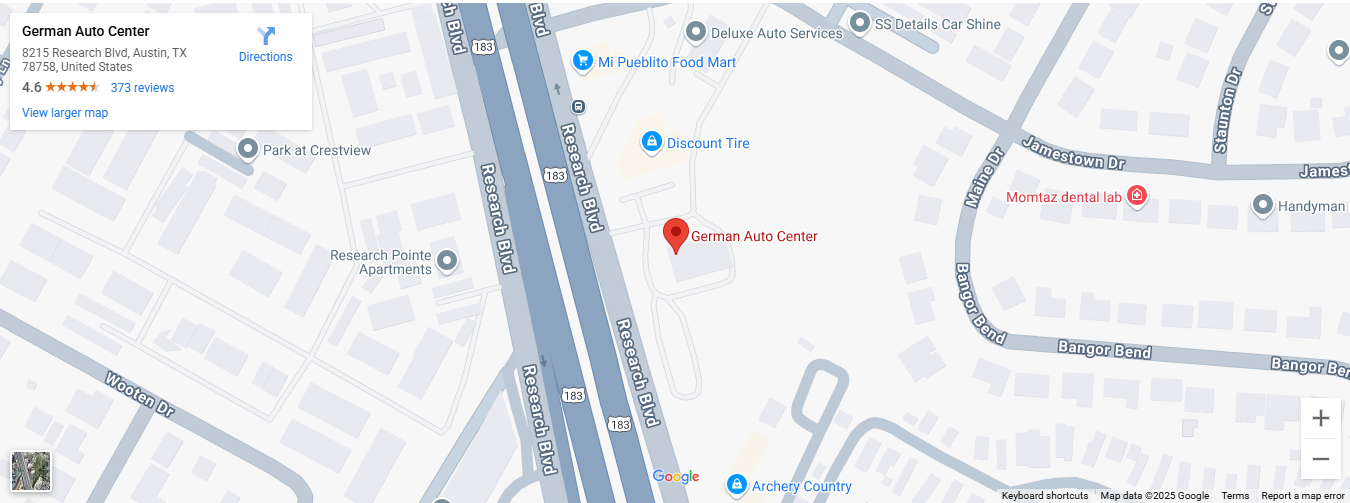
If your 2018 or newer BMW is showing any of the symptoms above and you want a straight answer on what’s going on, give us a call at (512) 452-6437 or schedule online. Bring it to 8215 Research Blvd and we’ll run a proper diagnostic, tell you exactly what we find, and give you an honest picture of what it needs and what can wait. No pressure, no guesswork.