The Porsche Boxster is one of the most rewarding sports cars you can own in Austin. It’s mid-engine, beautifully balanced, and at used prices it looks like one of the best deals in the enthusiast car market. For the right buyer, it is. For the unprepared buyer, it can become an expensive education.
At German Auto Center, we’ve been working on Porsche Boxsters since the 986 generation first arrived in 1996. The M96 engine that powers the 986 and early 987 has a well-documented set of failure points. Knowing what they are, what causes them, and what it actually costs to address them is the difference between a great used Boxster purchase and one you regret.
This guide is for buyers researching a used Boxster and for current owners who want to understand what’s ahead. We’ll cover the engine problems you’ll hear about, which ones actually matter at which mileage, realistic service costs in Austin, and how to approach ownership in a way that keeps the car running well without spending more than you need to.
Understanding the M96 and M97: The Engines Behind the 986 and 987 Boxster
The 986 Boxster (1997-2004) and the early 987 Boxster (2005-2008) both use variants of the M96 flat-six engine. The 987.2 (2009-2012) moved to the MA1 direct injection engine, which is a cleaner, more reliable unit. If you’re shopping a Boxster built before 2009, you’re dealing with M96 or M97 architecture, and the known failure points of those engines are what this guide is primarily about.
The M96 was genuinely innovative when it launched. Porsche moved the cooling system to a water-cooled design while keeping the traditional flat-six layout, and they developed new cylinder lining technology to do it. The engineering was ambitious. Some of it worked extremely well. Some of it created problems that have been talked about in Porsche forums ever since.
The M97, used in later 987 models, addressed some of the M96’s weaknesses but kept the same basic architecture. The IMS bearing design was improved but not fully resolved until the 987.2. Understanding which generation you’re buying is step one.
Porsche Boxster Engine Problems: What We Actually See in the Shop
There’s a lot of information online about Boxster engine problems, and some of it is accurate. Some of it is overblown. Here’s our honest take on what we see regularly, what we see occasionally, and what’s mostly forum noise at this point.
Intermediate Shaft Bearing Failure (IMS Bearing)
This is the one that gets the most attention, and for good reason. The intermediate shaft bearing on M96 and early M97 engines uses a sealed bearing that, over time, can fail without warning. When it goes, it typically takes the engine with it. We’ve seen IMS failures on cars with as few as 50,000 miles and on cars well past 100,000.
The failure rate is not as high as some forums suggest. But the consequence when it does fail is severe enough that any used Boxster purchase should include an assessment of the IMS bearing status. An IMS retrofit, which replaces the sealed bearing with an open, serviceable unit, runs approximately $2,000-$2,500 at our shop including the rear main seal replacement that should always be done at the same time. That’s inexpensive insurance on a car that could otherwise face an engine replacement.
On a 987.2 with the MA1 engine, the IMS concern goes away entirely. That’s one of the strongest arguments for the newer generation if your budget allows.
Rear Main Seal (RMS) Leaks
The rear main seal separates the engine from the transmission bell housing, and it’s a known weak point on M96 and M97 engines. A leaking RMS is messy and will eventually leave oil spots on your garage floor, but it doesn’t affect performance until the leak becomes significant enough to cause oil starvation.
On its own, an RMS replacement runs around $800-$1,200 in labor because the transmission needs to come out to access it. We almost always recommend doing the IMS retrofit and RMS replacement together when either one needs attention. The transmission has to come out either way, and the labor overlap makes the combined job meaningfully cheaper than doing them separately.
If you’re looking at a 986 or early 987 with no record of this work having been done, assume it’s coming and factor it into your offer price accordingly.
Air-Oil Separator Failure
The air-oil separator, sometimes called the AOS, is designed to prevent oil vapor from entering the intake system. When it fails, oil gets pulled into the intake and burned, causing increased oil consumption, blue smoke on startup, and in worse cases, a fouled throttle body and intake manifold.
AOS failure is common enough on higher-mileage M96 engines that we check it on every Boxster that comes in for service. The part itself is not expensive. Labor to replace it is moderate. Left unaddressed, it leads to more expensive problems downstream. If your Boxster is burning oil between changes or you’re seeing smoke at startup, this is the first place to look.
Cylinder Bore Scoring
This one is more serious. The M96 3.4L engine used in earlier 986 models had a cylinder lining design that, under certain conditions, develops scoring inside the bore. It’s associated with oil starvation events, extended oil change intervals, and the particular metallurgy of that specific engine. The 3.2L and later 3.4L engines are less susceptible.
Bore scoring typically shows up as increased oil consumption that worsens over time, sometimes accompanied by a metallic noise under load. A compression test and leakdown test will reveal it. This is one of the more expensive repairs when it’s confirmed, often requiring a full engine rebuild or replacement.
The honest answer on bore scoring is this: it’s not common on well-maintained cars, but it’s common enough on neglected ones that oil change history matters enormously when evaluating a used Boxster. More on that below.
VarioCam Solenoid and Tensioner Issues
VarioCam is Porsche’s variable valve timing system. The solenoids that control it can fail, causing rough idle, poor throttle response, and fault codes. Tensioner failures, particularly on pre-2000 engines, can cause timing issues that affect performance and, in severe cases, cause engine damage.
Solenoid replacement is a moderate repair. Tensioner issues on older engines are worth addressing proactively if there’s no record of it being done. Both show up in diagnostic scans before they become critical, which is another reason regular service matters.
Real Porsche Boxster Service Costs in Austin
One of the most common questions we get from prospective Boxster buyers is what service actually costs at an independent shop versus the dealership. Here’s a realistic picture based on what we see.
Oil service: We recommend every 5,000 miles on M96 and M97 engines, not the 10,000-mile interval Porsche officially calls for. The M96 oil sump has a relatively low capacity for a performance engine, and extended drain intervals accelerate wear on the very components most prone to failure. At our shop, an oil service on a Boxster runs $150-$200.
IMS retrofit plus RMS replacement: $2,000-$2,500. Should be done on any M96 or early M97 car without a record of this work.
Air-oil separator replacement: $400-$600 depending on condition of related components.
Coolant service: Every 4 years or 50,000 miles. In Austin’s heat, we lean toward the 4-year interval. Around $200-$250.
Brake service: Fluid every 2 years regardless of mileage. Pads and rotors vary widely by driving style and mileage.
Convertible top hydraulics: Hydraulic leaks and slow operation are common on higher-mileage cars. Repair costs vary significantly depending on where the leak originates.
Compared to dealership pricing, Porsche repair in Austin, TX at an independent Bosch Authorized shop runs 30-40% lower for the same work on the same car. Peter Awbrey, a Porsche owner who brought his car to us after years at the dealership, noted we do the work for roughly one third of what Porsche charges. The quality and the parts are the same. The overhead is different.
Mark Buzz came to us specifically after two frustrating experiences with the service department at Porsche Austin. His words: he needed “quality service at a realistic price.” That’s a reasonable expectation for any Boxster owner, and it’s what an independent Bosch Authorized shop should deliver.
What to Look For When Buying a Used Boxster in Austin
Maintenance history is everything on a used Boxster. A 987 with 95,000 miles and complete service records is a better buy than an 80,000-mile car with a clean exterior and no paperwork. The failure points on these engines are almost all accelerated by deferred maintenance. Oil that goes too long, coolant that’s never been changed, filters that haven’t been touched.
The specific questions to ask a seller: Has the IMS retrofit been done? Is there a record of regular oil changes at 5,000-mile intervals? Has the AOS been replaced? Any history of oil consumption issues? A seller who can answer these questions with documentation is a seller worth talking to. One who can’t answer them at all is telling you something.
Get a pre-purchase inspection before you commit. A qualified independent shop can run a compression and leakdown test, scan for fault codes including cleared ones, inspect the AOS condition, check for RMS leakage, and assess whether the IMS retrofit has been performed. That inspection, which runs $150-$250 at our shop, is the most important $200 you’ll spend in the buying process.
Klaus W., who has been bringing his Audi to us for years, told us: “They clearly describe what needs to be addressed on my car. They work with me and accommodate my needs and circumstances as much as possible. I don’t know any place in Austin that even comes close.” That same approach applies to every Boxster we inspect and service.
Owning a Boxster in Austin: What the Climate Adds to the Equation
Central Texas heat is hard on a few specific Boxster systems. Coolant degrades faster here than in moderate climates. The convertible top’s hydraulic fluid thins in extreme heat and thickens in the occasional cold snap, which accelerates wear on seals and cylinders. Tires age faster sitting in direct sun, and rubber components throughout the engine bay show more wear than on cars in cooler regions.
IH-35 and MoPac stop-and-go traffic also means more low-speed engine cycling, which puts more thermal stress on the cooling system than highway driving does. If your Boxster is primarily a city car in Austin, stay on top of coolant condition and keep an eye on operating temperature.
The good news: a well-maintained Boxster handles Austin’s climate well. These are built to perform under stress. The owners who have the most trouble are the ones who defer service because the car seems fine. On an M96 engine, fine can change quickly.
Frequently Asked Questions
What are the most common Porsche Boxster engine problems?
+
On 986 and early 987 models with the M96 or M97 engine, the most significant concerns are IMS bearing failure, rear main seal leaks, air-oil separator failure, cylinder bore scoring on 3.4L engines, and VarioCam solenoid issues. The IMS bearing carries the highest consequence if it fails. Most of these issues are manageable with proper maintenance intervals and proactive repairs.
Should I do the IMS retrofit on my Boxster?+
If you own an M96 or early M97 Boxster without a documented IMS retrofit, yes. The retrofit replaces the sealed factory bearing with an open, serviceable unit and eliminates the risk of catastrophic failure. Combined with an RMS replacement, the total cost at German Auto Center runs $2,000-$2,500. That’s inexpensive compared to the cost of an engine replacement.
How often should I change the oil on a Porsche Boxster?+
We recommend every 5,000 miles on M96 and M97 engines. The factory interval of 10,000 miles is too long for a performance engine with a relatively small sump and known sensitivity to oil starvation. Regular oil changes are the single most effective maintenance step for extending the life of a Boxster engine.
How much does Porsche Boxster service cost at an independent shop in Austin?
+
Routine service at German Auto Center runs 30-40% less than dealership pricing for comparable work. Oil service is $150-$200. An IMS retrofit with RMS replacement is $2,000-$2,500. Coolant service runs $200-$250. Pre-purchase inspections are $150-$250 depending on the depth of inspection requested.
Is the 987.2 Boxster more reliable than the 986 and early 987?
+
Yes, meaningfully so. The 987.2 (2009-2012) uses the MA1 direct injection engine, which eliminated the IMS bearing concern entirely and addressed several other M96 and M97 weak points. If your budget allows for a 2009 or newer car, the ownership experience is generally cleaner and the risk profile is lower.
Can German Auto Center service my Porsche Boxster?+
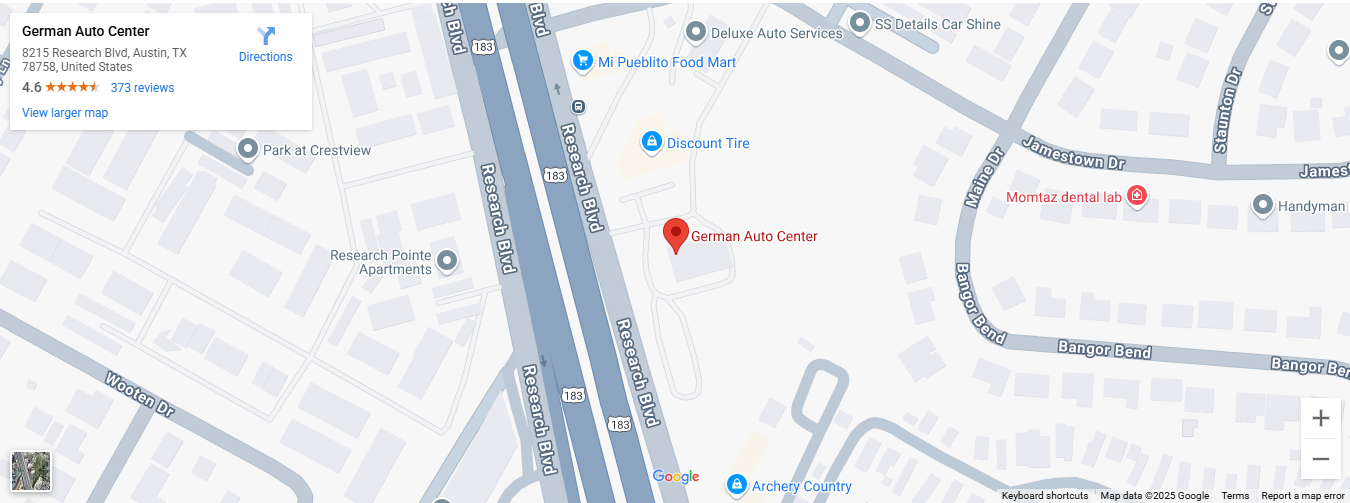
Yes. We service all Boxster generations at our shop at 8215 Research Blvd in Austin. We are a Bosch Authorized Service Center with over 45 years of Porsche experience and the diagnostic equipment to handle everything from routine service to complex engine repairs. Call us at (512) 452-6437 or schedule online.
If you’re buying a used Boxster and want to know what you’re actually getting, or if you already own one and want a shop that will give you straight answers on what it needs, give us a call at (512) 452-6437. Bring it by 8215 Research Blvd and we’ll walk you through exactly what we find. No pressure, no upsell.