A Porsche is one of the most maintenance-responsive vehicles you can own. Keep up with the service schedule and it will reward you with performance and reliability that holds up over a very long ownership period. Let it slide and the costs of catching up are steep, because almost every system in a Porsche is engineered to tight tolerances that amplify the consequences of deferred care.
At German Auto Center, we have been servicing Porsches in Austin since 1979. In that time we have learned one thing clearly: the factory maintenance schedule was not written for Austin. It was not written for sustained summer temperatures above 100 degrees, for the dust and limestone grit of the Hill Country, or for the stop-and-go heat cycling that an Austin commute puts on every fluid and seal in the car. This guide adjusts for all of that.
Whether you drive a 911, a Boxster, a Cayman, a Macan, or a Cayenne, the guidance below applies to Porsche ownership in Central Texas. We have organized it by system so you can focus on what matters most for the way you actually use your car.
Engine Oil: The Foundation of Everything Else on a Porsche
How often should I change the oil on my Porsche in Austin?
Porsche’s factory oil change interval on many current models runs to 10,000 miles under the OIL service indicator. On paper that looks reasonable. In Austin conditions it is more than we recommend for any Porsche used as a regular driver.
Heat degrades motor oil faster than mileage does. A Porsche sitting in traffic on 35 or MoPac in August with the engine at operating temperature and the air conditioning working hard is a different load profile than the highway cruise cycles the factory interval was calibrated around. Oil viscosity breaks down faster under sustained heat, the turbochargers on the 911 Turbo, Macan Turbo, and Cayenne Turbo generate significant heat that passes directly into the oil system, and contamination from combustion byproducts accumulates more quickly in short-trip urban driving than it does in long highway runs.
We recommend a 6,000 to 7,000-mile oil change interval for any Porsche driven primarily in Austin under typical conditions. On turbocharged models, we lean toward the lower end of that range. The oil itself must meet the Porsche A40 specification. Using an off-spec oil on a Porsche is not a minor issue. The A40 spec addresses shear stability, thermal resistance, and low-viscosity requirements specific to Porsche engine architecture. A generic full synthetic that meets generic standards is not the same thing.
The oil filter housing and drain plug torque matter on Porsche engines more than on many other cars. Over-tightened drain plugs strip the oil pan threads on aluminum pans, which is an expensive repair on a mid-engine Porsche where the oil pan access is limited. We see this regularly on cars that have been serviced at shops unfamiliar with Porsche-specific torque specifications.
Check your oil level once a month regardless of mileage. The 9A1 flat-six in the 991 and 992 911 and the 4.0-liter in the GT cars operate at the edge of their engineering tolerances, and running low between services does more cumulative damage than a slightly extended change interval would.
Cooling System Maintenance: Where Austin Summer Creates the Most Risk
Why does Austin heat matter more for Porsche cooling system maintenance?
The water-cooled Porsche engines introduced with the 996 generation in 1997 brought with them a set of cooling system maintenance requirements that matter more in Central Texas than in cooler markets. The ambient temperature from May through September in Austin means the cooling system operates at or near its design margin for an extended portion of the year. Components that are beginning to wear — the thermostat, the expansion tank, the water pump impeller on M96 and M97 engines — fail faster under sustained heat than they would in a milder climate.
The coolant reservoir is a pressurized plastic component that cycles between hot and cold with every drive. On higher-mileage 996 and 997 cars in particular, stress cracks develop over time that can lead to a sudden loss of pressure rather than a slow visible leak. The symptom is unexplained coolant level drop without an obvious leak at the hose connections or the radiators. A cooling system pressure test catches these cracks before they cause an overheating event.
The thermostat on all water-cooled Porsche models is worth proactive attention in Austin. A thermostat that is beginning to stick open runs the engine slightly cool and affects fuel efficiency and oil warm-up time. A thermostat beginning to stick closed is a more serious situation. The symptom of a failing thermostat is a temperature gauge that takes longer than usual to reach operating temperature, or one that has become less consistent than it used to be. On Austin summer drives, a thermostat that is marginal in spring can fail under full heat load by July.
We recommend a cooling system pressure test and coolant condition check every two years on any Porsche driven regularly in Central Texas, regardless of mileage. Coolant replacement every four years is appropriate for most Austin Porsche owners. Waiting for the coolant to visibly degrade or for a leak to appear is the wrong trigger on a car with this level of engineering precision.
Porsche Brake Maintenance: What Austin Driving Demands
How often should I change Porsche brake fluid in Austin?
Brake fluid is the most commonly deferred maintenance item on Porsches we see, and it is one of the highest-consequence ones to skip in a performance driving environment.
Brake fluid absorbs moisture from the atmosphere over time. As moisture content increases, the fluid’s boiling point drops. This matters on any car. It matters more on a Porsche driven the way Porsches are meant to be driven. An owner who takes their 911 out on Lime Creek Road or the Ranch Road 335 loop through the Hill Country is putting sustained load on the braking system in a way that can push degraded fluid toward its boiling point. Boiling brake fluid produces a compressible vapor pocket in the lines. The pedal goes soft exactly when you need it most.
Porsche specifies a brake fluid change every two years regardless of mileage, and that interval is one we agree with fully for Austin owners. Austin’s heat accelerates moisture uptake in the fluid, and owners who drive aggressively on Hill Country roads should treat two years as a firm deadline rather than a guideline. The fluid change is a straightforward service. A brake fluid boil event in a corner is not.
On brake pads and rotors, the Porsche brake pad wear sensor alerts you when the front pads have reached minimum thickness. Rear pads on most Porsche models do not have sensors. The early sign of rear pads approaching the limit is a faint metallic scraping during light brake application that disappears under harder stops. If you hear this, schedule an inspection. Driving rotors down to bare metal on a Porsche is an expensive outcome that is entirely avoidable.
The PCCB ceramic composite brake option on 911 Turbo and GT models requires specific attention. PCCB rotors are extremely effective and extremely unforgiving of incorrect pad compounds. If your car has the yellow Porsche brake calipers, verify that any pad replacements use pads specifically rated for ceramic rotors. Metallic pads on PCCB rotors destroy the rotor surface and the rotor replacement cost is significant.
A Porsche Macan owner who has brought her car to us twice described the service experience this way: the work was professionally performed and her car was ready sooner than she expected. That is the standard we hold on every Porsche that comes through the shop. Maintenance done correctly and on time is the foundation of a Porsche that performs the way it was designed to.
PDK and Transmission Service: Do Not Run This Past Its Interval in Texas Heat
How often should the PDK transmission be serviced on a Porsche in Austin?
The PDK dual-clutch gearbox is one of the finest performance transmissions in production, and it is sensitive to fluid condition in ways that matter in Austin’s operating environment.
Porsche originally marketed the PDK as a sealed unit requiring no fluid service under normal use. This has been revised, and most experienced Porsche independent specialists now recommend a fluid service every 40,000 miles under normal driving conditions. For Austin owners, we adjust that recommendation based on use pattern. A 911 driven on track days, a Macan used in sustained city traffic, or any Porsche driven aggressively in summer heat should be on the more conservative end of that interval.
The symptoms of a PDK that needs fluid attention build gradually. A slight shudder during low-speed engagement in stop-and-go traffic. A faint hesitation when selecting Drive or Reverse from Park that was not there before. Shift quality that has become slightly less crisp over a period of months. None of these symptoms are dramatic, and it is easy to normalize them over time. But degraded PDK fluid accelerates wear on the clutch packs and the internal mechatronics that control gear selection, and the repair cost for mechanical damage inside a PDK is orders of magnitude higher than the cost of a fluid service.
The Tiptronic transmission on older 911 and Cayenne models follows similar logic. A fluid and filter service every 40,000 miles under Austin conditions keeps the torque converter and solenoid assembly in good condition. We see Tiptronic-equipped Porsches come in with shift hesitation and torque converter shudder that resolves entirely after a proper fluid service. The same cars, if left for another 20,000 miles, would be facing component replacement rather than a fluid change.
Spark Plugs and Ignition System: What the MA1 and 9A1 Engines Need
When should I replace spark plugs on a Porsche 911?
The spark plug interval on a Porsche depends on the engine. On the MA1 naturally aspirated flat-six in the 991 and early 992, the factory interval is approximately 40,000 miles. On the turbocharged 9A1 in the 992 Carrera S and Turbo variants, we recommend inspecting plugs at 30,000 miles given the additional ignition demand that comes with forced induction.
Austin’s heat has a secondary effect on ignition system longevity that is worth understanding. The ignition coils on all water-cooled Porsche flat-six engines are mounted in tight positions near exhaust heat. Prolonged heat cycling accelerates the breakdown of the coil pack insulation and the boot seals that seat the coil against the spark plug. A coil pack that is beginning to fail produces an intermittent misfire that can be hard to reproduce during a cold diagnostic but shows up clearly during a warm driving cycle. If your 911 is running slightly rough at idle when fully warm but clears up at higher RPM, coil condition is a likely starting point.
On M96 and M97 engines in the 996 and 997, spark plug access requires removing the rear engine lid and working in a confined space. This is not a service to rush. Broken spark plugs in the M96 head are a more significant repair than the plug change itself. We see cross-threaded plugs and broken tips on cars that have been serviced by shops unfamiliar with the specific approach these engines require.
Drive Belt, Timing Chain, and Accessory Drive Maintenance
Does the Porsche 911 have a timing belt or a timing chain?
All current water-cooled Porsche 911 models use a timing chain rather than a timing belt. The 996, 997, 991, and 992 are all chain-driven engines. The chain drive is designed to be a long-life component, but it is not maintenance-free in the sense that oil quality and change intervals directly affect chain tensioner function and long-term chain stretch.
On M96 and M97 engines, the chain tensioner design is a known concern at higher mileage, particularly on cars that have run extended oil change intervals. The tensioner uses oil pressure to maintain chain tension. Worn or degraded oil reduces that pressure margin and accelerates tensioner wear. A brief metallic rattle on cold start that settles within a few seconds is an early tensioner warning sign on these engines. If the rattle persists longer than a few seconds or has become more pronounced over time, schedule an inspection before the next oil change interval.
The accessory drive belt — the serpentine belt that drives the alternator, power steering pump (on hydraulic-assist models), and air conditioning compressor — is a separate wear item. On most water-cooled Porsche models we recommend inspecting the belt and tensioner at 60,000 miles and replacing both proactively at 80,000 miles or if any cracking or glazing is visible. In Austin’s heat, belt compound hardens faster than in cooler climates, and a belt failure at highway speed takes other accessory components with it.
Porsche Boxster and Cayman owners with the M96 or M97 engine should be aware that the IMS bearing concern discussed in detail in our Porsche 911 warning signs guide applies equally to these models. The intermediate shaft bearing is the same component in the same engine family. If you have a 986 or 987 Boxster or a 987 Cayman with the M96 or M97 engine and have not had an IMS inspection or preventive replacement, we recommend scheduling one.
Tire and Alignment Maintenance on a Porsche in Austin
How often should I rotate and align the tires on a Porsche?
Tire rotation on a Porsche is more nuanced than on most cars. The 911 in particular uses staggered wheel and tire fitment — wider tires at the rear than the front — which means front-to-rear rotation is not possible on most configurations. The rotation pattern on a 911 is typically side-to-side on each axle, which maintains the directional wear pattern while evening out cornering wear between left and right sides.
Alignment on a Porsche should be checked annually in Austin. The road surface quality in Austin, the frequency of expansion joint impacts, and the occasional pothole create alignment disturbances that accumulate over time. Porsche’s rear multi-link suspension geometry is precise, and small alignment deviations produce uneven rear tire wear that is easy to miss until the tires need replacement. An annual alignment check costs far less than the set of rear tires that an out-of-spec alignment wears prematurely.
Tire age matters on a performance Porsche as much as tread depth. Tires that have spent multiple years in Austin’s summer UV and heat cycle harden and lose the grip and compliance the Porsche’s suspension was calibrated around. We recommend replacing any Porsche tire that is six or more years old regardless of remaining tread, and sooner on track-capable models where grip margins are used more fully.
On Porsche models with active suspension management or PASM (Porsche Active Suspension Management), the PASM calibration interacts with tire condition and geometry. If your 911 or Boxster has developed a handling characteristic that feels different from how it drove when new and a tire and alignment inspection does not resolve it, the PASM actuators and ride height sensors are worth including in the diagnostic.
Battery and Electrical Maintenance: What Porsche Owners in Austin Need to Know
Why does Austin summer heat kill car batteries faster?
Heat degrades batteries faster than cold does. The popular belief that winter is what kills batteries is backward. Batteries weakened by summer heat in Austin are the ones that fail to start on a cold January morning. Austin’s climate produces higher average battery temperatures than most parts of the country, and we see a meaningfully higher frequency of battery-related electrical faults on Austin Porsches than the mileage alone would predict.
On modern Porsches, battery degradation does not always announce itself as a failure to start. It announces itself as multiple unrelated warning lights appearing simultaneously, PCM system resets, PDK transmission hesitation codes, PASM fault messages, and PSM warnings that come and go without a consistent pattern. The integrated electronics architecture shares voltage across all of these systems, and unstable voltage from a degraded battery triggers faults across unrelated modules. A new battery, properly registered with PIWIS-compatible software, clears all of them at once.
Battery registration is a step that is often skipped when a Porsche battery is replaced at a general shop. The registration procedure tells the charging system the age and capacity of the new battery. Without it, the charging system continues to treat the new battery as a worn one and can either undercharge or overcharge it. We perform battery registration on every Porsche battery replacement using the same PIWIS-compatible software we use for full diagnostics.
Mark Buzz found us after two unsatisfactory experiences with the service department at Porsche Austin. What he was looking for was straightforward: quality service at a realistic price with communication he could trust. That is the consistent experience we try to deliver. Porsche maintenance does not have to cost what the dealership charges, and it does not have to feel transactional.
A Practical Porsche Maintenance Schedule for Austin Driving
The intervals below are adjusted for Central Texas conditions. Where they differ from Porsche’s factory schedule, they reflect what we see in the shop from cars maintained under Austin’s specific operating environment.
Every 6,000 to 7,000 miles: Oil and filter change using Porsche A40-spec full synthetic. Oil level check monthly between services on all models.
Every 20,000 to 30,000 miles: Cabin air filter replacement. Engine air filter inspection. Tire rotation per applicable Porsche rotation pattern. Brake pad thickness inspection.
Every 2 years regardless of mileage: Brake fluid replacement. Coolant condition check and cooling system pressure test. Battery condition test on cars over 3 years old.
Every 30,000 to 40,000 miles: Spark plug inspection on naturally aspirated models. PDK or Tiptronic transmission fluid service. Drive belt and tensioner inspection.
Every 60,000 miles: Spark plug replacement on turbocharged models. Alignment verification. Suspension component inspection. IMS bearing inspection on 996 and early 997 cars if not already addressed.
Every 4 years or 80,000 miles: Coolant replacement. Accessory drive belt and tensioner replacement on higher-mileage cars. Tire age evaluation regardless of tread depth.
As needed based on symptoms: Sunroof drain flush on any Porsche with a sunroof or panoramic roof. Convertible top mechanism inspection on Boxster and 911 Cabriolet. PASM actuator check if handling has changed without an obvious cause.
Why Austin Porsche Owners Choose Independent Service for Regular Maintenance
Porsche dealer labor rates in Austin are among the highest in the market. For owners who drive their Porsche regularly and maintain it on an appropriate schedule, the cumulative cost of dealer servicing is significant. An Austin Porsche Repair Shop with the right equipment, Porsche-specific expertise, and OEM-quality parts delivers the same standard of maintenance at considerably lower cost.
The equipment requirement is real and non-negotiable on a Porsche. PIWIS-compatible diagnostic software is required for battery registration, PASM calibration, PDK adaptation values after a fluid service, and full fault code access across the entire module network. A shop performing Porsche maintenance without manufacturer-equivalent tools is doing incomplete work regardless of how skilled or well-intentioned the technician is.
We are a Bosch Authorized Service Center with PIWIS-compatible diagnostic equipment, ASE-certified technicians, and over 45 years of Porsche service experience in Austin. We use Bosch-supplied OEM components on every car and we perform every procedure to Porsche specification. The maintenance history we build for your car is accurate and complete, which matters both for your ownership experience and for resale value.
Jim Rado, a customer who has been with us for years, described his experience with a phrase that stuck with us: “Car was taken care of to the minutest detail.” That is exactly what Porsche maintenance requires. The details are not optional on a precision-engineered car. They are what the whole system depends on.
Frequently Asked Questions
How often should I change the oil on my Porsche in Austin?
+
We recommend every 6,000 to 7,000 miles for Porsches driven regularly in Austin. The factory 10,000-mile interval does not account for sustained summer heat and urban stop-and-go driving. On turbocharged models the lower end of that range is appropriate. Always use a Porsche A40-specification full synthetic oil.
How often should the PDK transmission fluid be changed on a Porsche?+
Every 40,000 miles under Austin driving conditions. The original sealed-for-life claim has not held up, and degraded PDK fluid produces shudder, hesitation, and low-speed engagement issues that resolve with a proper fluid service. Austin stop-and-go driving is harder on the PDK clutch packs than highway driving, and the conservative end of the interval range is appropriate here.
Does Porsche maintenance need to be done at a dealership to maintain warranty?+
No. In the United States, federal law under the Magnuson-Moss Warranty Act prohibits manufacturers from requiring dealer-only service as a condition of warranty coverage, provided the service is performed correctly using appropriate parts. An independent shop using OEM-quality components and proper Porsche-specific procedures satisfies the warranty maintenance requirement.
How does Austin heat affect my Porsche’s brake fluid?+
Austin heat accelerates moisture absorption in brake fluid, lowering its boiling point faster than in cooler climates. For owners who drive on Hill Country roads or use their Porsche at track events, degraded brake fluid is a genuine safety concern. We recommend a firm two-year brake fluid change interval for Austin Porsche owners regardless of mileage.
Where can I find a reliable Porsche Repair Shop in Austin for scheduled maintenance?+
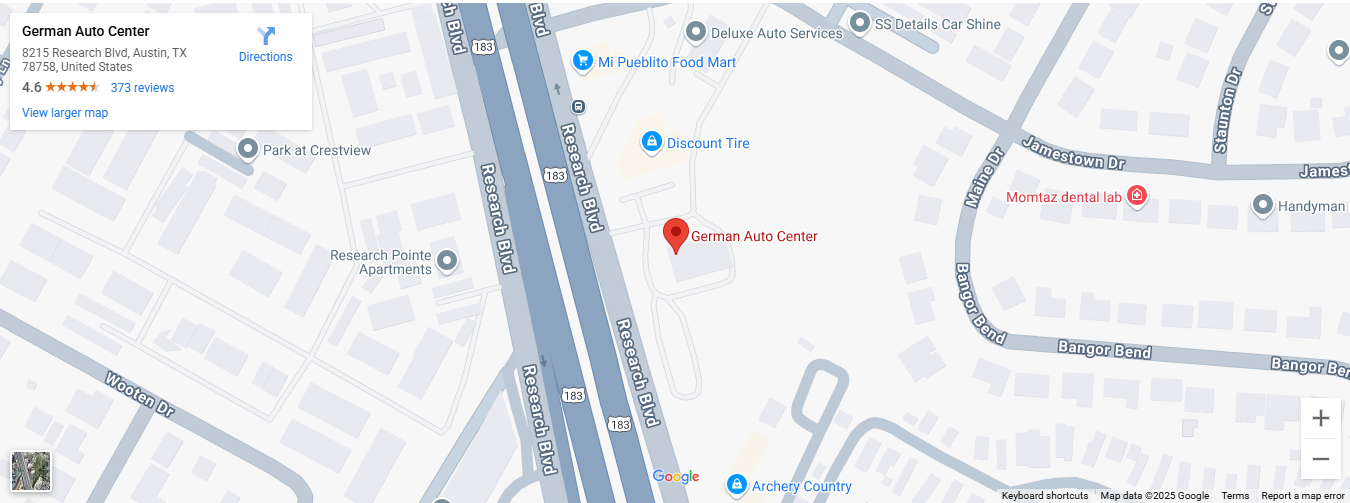
German Auto Center at 8215 Research Blvd, Austin TX 78758. We are a Bosch Authorized Service Center with PIWIS-compatible diagnostic equipment and over 45 years of Porsche service experience in Austin. We service all Porsche models including the 911, Boxster, Cayman, Macan, Cayenne, and Panamera. Call (512) 452-6437 or schedule online at germanautocenter.com.
Is it worth taking my Porsche to an independent shop for an oil change if the dealership is nearby?+
Yes, for most owners. The oil change procedure on a Porsche requires the correct A40-spec oil, proper drain plug torque on an aluminum oil pan, and ideally an oil life reset through PIWIS-compatible software. These requirements are met at a qualified independent shop and the labor cost is meaningfully lower than the dealership. The savings compound over a regular maintenance relationship.
If you want a maintenance plan for your Porsche that is built around how you actually drive in Austin rather than a generic factory schedule, call us at (512) 452-6437 or schedule online. Bring it to 8215 Research Blvd and we will go through the service history, tell you what is due, and give you an honest picture of where the car stands. No pressure, no upsell.