The Porsche 911 is one of the most over-analyzed cars in automotive history. Enthusiasts have catalogued its problems by generation, by engine code, by VIN range. If you own a 911 and you’ve spent any time in forums, you’ve read the warnings about the IMS bearing, the RMS, the AOS, the M96 cylinder liner. Some of it is well-founded. Some of it is overcorrected fear based on early reports that have taken on a life of their own online.
At German Auto Center, we have been diagnosing and repairing Porsche 911s in Austin since 1979. We have worked on 996s, 997s, 991s, and 992s. We know which warning signs on a 911 demand immediate attention, which ones can be monitored for a short period, and which ones are commonly misunderstood. This guide covers all three, by symptom and by generation where the failure pattern differs.
The 911 rewards attentive ownership more than almost any other car. Catch a problem early and it is usually a manageable repair. Ignore it and the costs escalate fast. Understanding what your car is trying to tell you is the starting point for everything else.
Oil Leaks on the Porsche 911: Which Generation, Which Seal, What It Means
What causes oil leaks on a Porsche 911?
Oil leaks are the most common complaint we address on 911s across all generations, and the location of the leak tells you a great deal about the engine’s condition and the cost of the repair. On a 911, not all oil leaks are equal.
On the M96 and M97 engines found in the 996 and 997, the rear main seal is a frequent leak point on higher-mileage cars. The RMS sits at the back of the engine where it meets the transaxle, and replacing it on a 911 requires dropping the engine. It is not a short job. The related air-oil separator, sometimes called the AOS, is another high-frequency failure on these engines. When the AOS fails, it pushes oil vapor into the intake system and causes a visible blue smoke at startup and sometimes a burning oil smell during normal driving. On the 996 and 997, the valve cover gaskets are also a regular oil seep source, particularly on the rear cylinder bank where the gasket runs close to exhaust heat.
On the 991 and 992 using the MA1 flat-six in naturally aspirated form and the EA9B1 in the Turbo variants, the failure points shift. The MA1 is a more robust engine in many respects, but it is not immune to oil leaks. The camshaft housing seals and chain housing gaskets are the most common external leak sources on later 991s. A slow seep here can go unnoticed for a long time before it shows up as a burning smell or a low oil level warning.
Any oil leak on a 911 deserves a proper diagnosis before you decide how urgent it is. Some leaks are slow and stable. Others accelerate. And on a mid-engine car where the engine sits behind the passenger compartment, leaks that reach exhaust components create a fire risk that does not exist on front-engine vehicles in the same way. If you smell burning oil on a 911, take it seriously.
The IMS Bearing: What Every 996 and 997 Owner Should Actually Know
How do I know if my Porsche 911 has an IMS bearing problem?
The intermediate shaft bearing failure on M96 and M97 engines is the most discussed Porsche reliability issue in the enthusiast community, and also one of the most misunderstood. Here is a grounded assessment based on what we have actually seen in the shop.
The IMS is a bearing supporting the intermediate shaft that drives the camshafts via chain. On early M96 engines in the 996 (1997 through approximately 2005), the original dual-row bearing design has a documented failure rate that is worth taking seriously. The revised single-row bearing used from approximately 2000 onward is somewhat less prone to failure, but still not immune. The 997 transitioned to a larger, more robust bearing design that has a meaningfully lower failure incidence.
The problem with IMS bearing failure is that it often produces no warning. The bearing can collapse suddenly, sending metal debris through the engine and causing catastrophic internal damage. However, some failures do produce early signs. A faint metallic grinding or ticking at idle that was not there before, a change in oil pressure behavior, or fine metallic particles visible in an oil analysis are all indicators worth investigating immediately on a 996 or early 997.
If you own a 996 or early 997 and have not had an IMS inspection or preventive bearing replacement, we strongly recommend scheduling one. A properly performed IMS retrofit using a quality bearing kit is a fraction of the cost of an engine rebuild after a bearing failure. It is one of the clearest cases where preventive maintenance on a 911 makes both mechanical and financial sense.
Chris Fan, a customer who came to us after a Porsche repair performed by another shop left him uncertain about the quality of the work, described the experience of working with our team during a complex diagnosis: the situation was handled with thorough expertise and clear communication that put him at ease about what had actually been done to his car. That is the standard we hold on every diagnosis, but especially on high-stakes engine work like this.
Check Engine Light on a Porsche 911: What It Typically Means by Generation
Should I keep driving my Porsche 911 with the check engine light on?
A steady check engine light on a 911 with no change in driving behavior warrants a prompt diagnostic but is generally not a stop-the-car emergency. A flashing check engine light on a 911 is a different situation. A flashing CEL indicates an active misfire, and continuing to drive a 911 with a misfire under load will damage the catalytic converters. The cats on a 911 are expensive and the labor to reach them is significant.
On the 996 and 997 with M96 or M97 engines, the most frequent check engine causes we see are VarioCam solenoid faults, mass airflow sensor failures, and DME relay issues. The VarioCam system controls variable valve timing on the 911, and when a solenoid fails it typically presents as a check engine light combined with a slight loss of power at mid-range RPM. The MAF sensor on these cars is sensitive to contamination from Austin’s dust and heat and should be one of the first things checked when a lean or fuel trim code appears.
On the 991 with the MA1 engine, we see oxygen sensor faults, PDCC (Porsche Dynamic Chassis Control) related codes on equipped models, and occasionally catalytic converter efficiency faults on higher-mileage cars. The 992 with its more comprehensive onboard monitoring surfaces faults more readily, which means warning lights appear earlier in the failure progression than they would on older cars. This is actually useful — a fault that triggers a CEL on a 992 at the first sign of trouble would have gone undetected for much longer on a 996.
Porsche uses its own PIWIS diagnostic software architecture. Reading fault codes accurately on a 911 requires PIWIS-compatible or equivalent manufacturer-level diagnostic tools. A shop diagnosing your 911 with a generic OBDII scanner is working with incomplete information regardless of how experienced the technician is.
Cooling System Warnings and the M96 Cylinder Liner Risk
What causes coolant loss on a Porsche 911?
The M96 engine used in the 996 has a well-documented susceptibility to cracked cylinder liners on the outer cylinders, particularly on high-mileage cars that have experienced overheating events. When a liner cracks, the result is coolant loss that can be slow and persistent or sudden, depending on where the crack is located and how it progresses. The symptom pattern is coolant level that drops without an obvious external leak, sometimes accompanied by a faint sweet smell from the engine bay or white exhaust at startup.
If you own a 996 with over 80,000 miles and notice unexplained coolant loss, do not assume it is a minor hose seep without having it properly investigated. A cooling system pressure test is the starting point. A cracked liner found early, before the engine has been run low on coolant repeatedly, is a serious repair but a recoverable one. An M96 that has experienced multiple overheating events from persistent coolant loss is a significantly more expensive conversation.
On the 997 and later cars, the cylinder liner issue does not carry over in the same form. The 997’s MA1 engine architecture addresses most of the M96’s known structural weaknesses. But cooling system maintenance is still important on all 911 generations. The coolant reservoir can develop slow leaks on higher-mileage 997s and early 991s, and the thermostat on any generation 911 is worth inspecting if the temperature gauge is behaving inconsistently or if the cabin heat takes longer than usual to warm up.
Austin’s summer heat means the 911’s cooling system operates at higher ambient temperatures for a larger portion of the year than in most climates. We recommend a cooling system pressure test every three years on any 911 driven regularly in Central Texas, regardless of mileage or generation.
Transmission Warning Signs on the Porsche 911
What does difficulty shifting or a grinding noise mean on a Porsche 911?
The G50 and G96 manual gearboxes fitted to air-cooled and early water-cooled 911s are generally robust, but they have known weak points. Difficulty engaging second gear from a downshift, a crunching or grinding sensation when pushing the shift lever into gear under acceleration, and a notchy feel that has developed gradually over time are all signs the synchros are wearing. On the 996 and 997, second gear synchro wear is the most common manual transmission issue we address. It typically presents in higher-mileage cars and often worsens if transmission fluid has been run past its service life.
On Tiptronic-equipped 996s and early 997s, we see torque converter issues and solenoid wear that produce hesitation during gear changes, a slight shudder when coming to a stop, and transmission fault codes that can be misread as electrical issues. A fluid and filter service on the Tiptronic often resolves early symptoms before they escalate to component replacement.
The PDK dual-clutch gearbox on 991 and 992 models is an exceptional transmission that shares many of the same maintenance sensitivities as Audi’s S tronic. Fluid service every 40,000 miles is appropriate for Austin driving conditions. Early symptoms of a PDK that needs attention include a shudder during low-speed engagement in heavy traffic, a slight hesitation when selecting Drive from Park that was not present before, and shift quality that has softened over time without a single triggering event.
Any 911 transmission diagnosis requires reading the specific fault codes stored in the transmission control module, not just the powertrain fault codes surfaced by a generic scan. We use PIWIS-compatible equipment to reach the full fault history on every 911 transmission we diagnose.
Peter Awbrey, who owns a Porsche and has been bringing it to us after comparing our work to what the Porsche dealership charges, put the value proposition plainly: our work is done at a fraction of what Porsche Austin charges, and the technical standard is the same. That is the relationship we aim to build with every 911 owner in Austin.
Electrical Faults, ABS Warnings, and Hydraulic System Issues
What causes the ABS warning light on a Porsche 911?
ABS warning lights on 911s across all generations most commonly point to wheel speed sensor faults or corrosion on the ABS control unit connections. On 996 and 997 cars that have accumulated mileage in Austin’s humidity and heat cycles, the ABS sensor wiring and connector condition is worth inspecting as part of any diagnostic that involves an ABS code. The sensors themselves are not expensive, but a corroded connector that intermittently loses signal can produce fault codes that look more serious than the underlying cause.
On 996 and 997 Carrera 4 models and the 911 Turbo, pinion failures in the front differential are a documented issue that shows up as a vibration or shudder under acceleration at low speeds, sometimes accompanied by a clunking noise when the AWD system engages. This is a drivetrain mechanical issue rather than an electrical one, but it commonly triggers stability control warning lights because the AWD system detects anomalous behavior from the affected driveline component.
The high-pressure hydraulic accumulator on some 996 models is worth knowing about. It stores hydraulic pressure for the braking system, and when it fails the result is reduced brake pedal feel and, in advanced cases, a car that may not start because the system cannot build sufficient pressure. If you own a 996 and notice the brake pedal feels different on a cold start versus after the car has been running for a few minutes, have the accumulator and brake system pressure tested.
On the electrical side, the 996’s DME relay is a known failure item. The DME (Digital Motor Electronics) relay controls power to the engine management system, and when it fails intermittently the car may crank without starting, stall suddenly, or run rough. The relay is not an expensive part. Diagnosing it correctly before throwing parts at a no-start condition requires reading live data from the DME rather than just checking fault codes in memory.
Targa Water Leaks, Cabriolet Top Failures, and Sunroof Drain Issues
Why does my Porsche 911 Targa or Cabriolet have water inside the cabin?
Water intrusion on 911 Targa models is a known issue that traces to the seal around the vent wing and the Targa top sealing system. When these seals age and harden, water finds its way into the cabin during heavy rain or car washes. The water typically accumulates in the footwells and behind the dash. Left unaddressed, it damages the carpet, the insulation, and the electrical components that sit low in the cabin.
On 911 Cabriolet models, the convertible top drive mechanism and the support struts for the hood and rear lid are wear items that need periodic attention. A Cabriolet top that operates more slowly than it used to, makes grinding noises during operation, or fails to latch securely at speed is showing early signs of drive mechanism wear. Catching it early means a mechanism service or drive component replacement. Ignoring it until the top fails mid-operation is a more expensive and inconvenient outcome.
The sunroof drain channels on 911 models equipped with a sunroof or panoramic roof follow the same pattern we see on other German cars in Austin. The drain channels clog with debris over time, backing water up into the headliner and eventually into the cabin. An annual drain flush is a five-minute preventive measure that avoids water damage to interior and electronic components.
Which Porsche 911 Warning Signs Are Urgent and Which Can Wait
Here is a practical breakdown based on what we see in the shop. The 911’s performance engineering means some warning signs escalate faster than they would on a less performance-oriented car.
Stop driving, address immediately: Oil pressure warning light, temperature gauge climbing above normal, flashing check engine light with rough running, sudden loss of power accompanied by mechanical noise, any smoke from the engine compartment, brake pedal feel that changes suddenly.
Schedule within 24 to 48 hours: Flashing check engine light without roughness, transmission fault message, ABS warning with unusual pedal behavior, coolant level that has dropped without a visible external leak, cold-start metallic ticking on a 996 or 997 that persists longer than a few seconds.
Schedule within the week: Steady check engine light with normal driving behavior, oil seep at the valve cover or AOS with no burning smell, mild shift hesitation on PDK that is not worsening, Targa or Cabriolet seal behavior that has changed.
When unsure: Call us at (512) 452-6437. A short conversation usually tells you which category you are in and whether it is safe to drive to us or worth having the car transported.
Why Austin Porsche 911 Owners Choose Independent Service Over the Dealership
Porsche Austin dealership labor rates are among the highest in the market. For owners who drive a 911 as a daily or regular-use car, the cost of dealer servicing adds up quickly. An independent Porsche shop in Austin with the right diagnostic equipment, Porsche-specific technical knowledge, and OEM-quality parts delivers equivalent work at a significantly lower cost. For major repairs like an IMS retrofit, an RMS replacement, or a PDK fluid service, the savings over dealer pricing are meaningful.
The diagnostic equipment piece is important on a 911 specifically. PIWIS-compatible tools access fault codes and live data across all of the 911’s control modules, including the DME, the PDK or Tiptronic TCU, the ABS/stability control module, and the PDCC system on equipped cars. A shop using generic tools on a 911 is not seeing the full picture, and misdiagnosis on a Porsche is expensive.
A Porsche owner who found us after reading reviews online described the experience simply: the team treated him better than the dealer and the price was considerably better. That is the feedback we hear consistently from 911 owners who make the transition from dealership service to independent service with us. The work quality is the same. The communication is better. The bill is lower.
Frequently Asked Questions
What are the most common Porsche 911 problems in Austin?
+
The most frequent 911 issues we address include oil leaks from the RMS, AOS, and valve cover gaskets on M96 and M97 engines. IMS bearing wear on 996 and early 997 cars. VarioCam solenoid faults and MAF sensor failures triggering check engine lights. Coolant loss on higher-mileage 996s from cracked cylinder liners or reservoir leaks. Second gear synchro wear on manual gearboxes. PDK fluid degradation causing shudder on 991 and 992 cars. ABS sensor and connector corrosion. Water intrusion on Targa and Cabriolet models.
Is the Porsche 911 IMS bearing failure as common as forums suggest?+
IMS failure is a real risk on 996s and early 997s, particularly on the earliest M96 engines with the dual-row bearing. The failure rate in that specific population is high enough to take seriously. On the later single-row bearing and especially on 997 cars with the larger bearing, the incidence is lower. A preventive IMS retrofit on a 996 or early 997 is a sound investment that eliminates the risk at a fraction of what engine damage from a bearing failure costs.
How much does Porsche 911 service cost at an independent shop versus the dealership in Austin?+
Independent shop rates in Austin run 30 to 40 percent below Porsche dealer labor rates for comparable diagnostic and repair work. On major 911 jobs like an engine-out repair, an IMS retrofit, or a PDK overhaul, the cost difference is substantial. German Auto Center is a Bosch Authorized Service Center with over 45 years of Porsche experience and PIWIS-compatible diagnostic equipment.
What does the VarioCam fault light mean on a Porsche 911?+
A VarioCam fault on a 996 or 997 typically indicates a solenoid has failed or is performing outside specification. The VarioCam system controls variable valve timing and affects mid-range power delivery. A failing solenoid usually produces a check engine light combined with a slight power loss at certain RPM ranges. The solenoid itself is a relatively accessible repair. Leaving it unaddressed causes the engine management system to run a fixed timing map that is less efficient and less powerful than the design intended.
Does German Auto Center offer Porsche Repair in Austin across all 911 generations?+
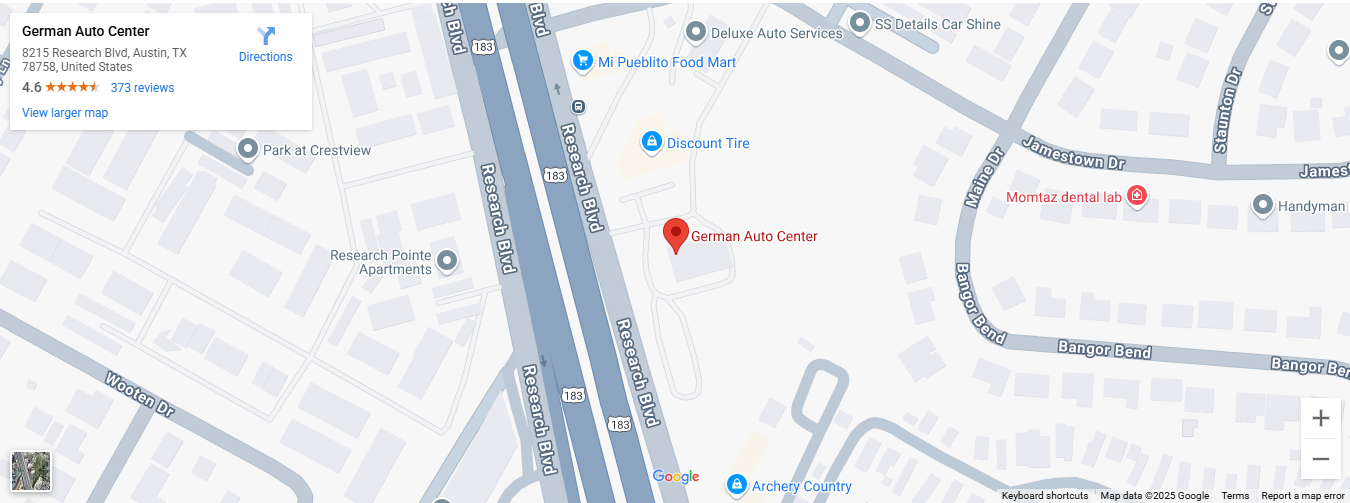
Yes. We service 996, 997, 991, and 992 generation 911s, including Carrera, Carrera 4, Carrera S, Targa, Cabriolet, and Turbo variants. We also service the Boxster, Cayman, Macan, Cayenne, and Panamera. Our shop is at 8215 Research Blvd, Austin TX 78758. Call (512) 452-6437 or schedule online at germanautocenter.com.
What should I do if my Porsche 911 check engine light is flashing?+
Reduce load on the engine immediately. Do not accelerate hard or hold high RPM. A flashing check engine light on a 911 indicates an active misfire, and sustained misfires cause catalytic converter damage that is expensive to repair. Drive to a safe location, reduce speed, and call us at (512) 452-6437 to discuss whether to drive the car in or have it transported.
If your Porsche 911 is showing any of the warning signs above and you want a straight answer on what is actually happening, call us at (512) 452-6437 or schedule online. Bring it to 8215 Research Blvd in Austin and we will run a proper diagnostic using PIWIS-compatible equipment, give you an honest assessment of what we find, and tell you exactly what it needs and what can safely wait. No pressure, no guesswork.