The Porsche Macan has become one of the most popular vehicles on Austin roads, and it’s easy to understand why. It drives more like a sports car than an SUV, it handles Central Texas traffic without feeling like a compromise, and it holds its value better
than almost anything else in the compact luxury crossover segment.
It also has specific service requirements and known failure patterns that every Macan owner should understand. At German Auto Center, we service 2018 and newer Porsche Macan models — the 95B facelift and the completely redesigned 2019 and newer cars — and we’ve developed a clear picture of what these vehicles need and where they tend to develop problems as the miles accumulate.
If you own a 2018-2023 Macan and you’re navigating service decisions — especially now that many of these cars are out of their original warranty coverage — this guide covers what actually matters.
Which Macan Are You Actually Driving? The Generations Matter
Porsche made significant changes to the Macan across the model years we service. Understanding which version you have changes the service priorities considerably.
2018-2021 Macan (95B Facelift)
The 2018 model year brought a significant update to the original 95B Macan platform. The base model Macan dropped the V6 in favor of a turbocharged 2.0-liter four-cylinder (EA888 derived, producing 248 horsepower). The Macan S continued with the 3.0-liter EA839 twin-turbocharged V6 at 348 horsepower, and the Macan GTS and Turbo used variants of the same 3.0T at higher output levels.
This generation runs a 7-speed PDK dual-clutch transmission paired with Porsche’s Traction Management all-wheel drive system. It’s a capable and refined package. The PDK in particular is excellent when properly maintained — and shows wear quickly when it isn’t.
The 95B platform was also Porsche’s first Macan generation to share more components with the Audi Q5 platform, which actually works in owners’ favor. Some service parts are more accessible and less expensive than on pure Porsche platforms, and independent shops familiar with both brands can service these cars efficiently.
2019-2023 Macan (Revised 95B)
Porsche updated the Macan again for 2019 with revised exterior styling, updated PASM suspension calibration, and the Sport Chrono package becoming more widely available as standard equipment on higher trims. Engine options remained largely the same, but software calibration and fuel injection mapping were refined.
For service purposes, the 2019-2023 cars are very similar to the 2018 facelift. The same inspection priorities apply, and the same known issues show up across both sub-generations. If you’re unsure which variant you have, the VIN will tell us immediately when you call.
Porsche Macan Common Problems on 2018 and Newer Models
The 2018+ Macan is a well-engineered vehicle and not unusually problematic for its class. But after seeing enough of them come through the shop, patterns emerge. Here’s what we actually find.
PDK Transmission Service: The Most Skipped Maintenance Item
The 7-speed PDK dual-clutch transmission in the 2018+ Macan is one of the best transmissions Porsche makes. It’s fast, precise, and extremely durable when the fluid is serviced at proper intervals. Porsche calls the PDK fluid a lifetime fill. We disagree.
In practice, PDK fluid degrades with heat cycling over time. In Austin’s climate, where the transmission works hard in stop-and-go traffic on IH-35 and Loop 1, fluid degradation happens faster than in moderate climates. We recommend a PDK fluid exchange every 40,000-50,000 miles. The cost is modest. The consequence of skipping it — mechatronic unit wear, rough shifts, and eventually transmission damage — is not.
The early signs of a PDK that needs service are subtle: a slight hesitation when selecting Drive from Park, an occasional shudder at low speeds during gentle acceleration, or shift quality that feels slightly less crisp than when the car was new. Most owners adapt to these changes without realizing anything has changed. A fluid exchange at the right interval prevents them entirely.
Oil Consumption and PCV System on the 2.0T
The EA888-derived 2.0-liter four-cylinder in the base Macan is a strong engine, but it shares a characteristic with other direct injection turbocharged fours: it can consume oil between changes, particularly as mileage accumulates. On a 2018+ Macan 2.0T, we consider consumption of up to half a quart per 3,000 miles within normal range. More than that warrants investigation.
The most common cause we find on higher-mileage 2.0T Macans is positive crankcase ventilation (PCV) system wear. The PCV system manages oil vapor from the crankcase, and when it fails or develops leaks, oil vapor gets pulled into the intake system. The result is increased oil consumption, potential carbon buildup on the intake valves, and occasionally a rough idle or slight drop in power.
Carbon buildup on the intake valves is a separate but related maintenance item on both the 2.0T and 3.0T. Direct injection engines don’t wash the valves with fuel the way older port injection engines did, so carbon deposits accumulate over time. On a Macan that hasn’t had intake valve cleaning by 60,000-70,000 miles, the buildup can be thick enough to affect throttle response and idle quality. Walnut blasting addresses it without removing the cylinder head.
Timing Chain on the 3.0T EA839
The 3.0-liter twin-turbo V6 in the Macan S, GTS, and Turbo is a genuinely excellent engine. The EA839 architecture is refined, powerful, and smooth. It does have one known concern worth monitoring: timing chain tensioner wear on early examples, particularly pre-2020 cars with higher mileage.
Timing chain issues on the EA839 typically present as a cold-start rattle that disappears once oil pressure builds — usually within the first few seconds of startup. If you’re hearing a brief metallic rattle on cold starts that goes away quickly, have it diagnosed before assuming it’s normal. On some cars it is normal break-in behavior. On others it’s an early indicator of tensioner wear that’s far less expensive to address before the chain becomes the problem.
We check the timing chain system on every 3.0T Macan that comes in for a major service interval, particularly on cars that have run extended oil change intervals. Clean, fresh oil is the single best preventive measure for timing chain longevity on this engine.
Air Suspension (PASM) Wear
The Porsche Active Suspension Management system on PASM-equipped Macans is one of the features that makes the car drive the way it does — controlled, flat, and composed in corners while remaining comfortable on rough roads. It’s also a system that wears over time.
The most common PASM issues we see on higher-mileage 2018+ Macans are air strut leaks and compressor wear. An air strut leak typically presents as the car sitting lower on one corner after sitting overnight, sometimes accompanied by the compressor running longer than usual to compensate. The compressor itself can wear out on cars that have dealt with chronic slow leaks — it runs more frequently to maintain ride height and accumulates hours faster than it should.
Austin’s roads are not the smoothest in Texas. IH-35 and some of the older surface streets in Central Austin put real wear on suspension components. If your Macan is showing uneven ride height, a longer compressor cycle than usual, or a ride quality that feels different corner to corner, have the PASM system inspected before a slow leak becomes a compressor replacement.
Brake Wear: Lower Than Expected, But Not Zero
The Macan uses regenerative-style brake bias calibration that keeps the front brakes working harder than the rears in most driving situations. As a result, front pad and rotor wear on the Macan can be faster than owners expect for a Porsche. On a car driven primarily in Austin city traffic with frequent stops on South Congress or Lamar, front brake service at 30,000-40,000 miles is not unusual.
We check brake pad thickness and rotor condition on every Macan service regardless of mileage. Porsche’s factory brake wear indicators tend to alert late — meaning by the time the sensor triggers, the pads are already at minimum thickness. Catching wear at 20-25% remaining saves rotors, which is where the real money is on a Porsche brake job.
Porsche Macan Service Intervals: What 2018+ Owners Actually Need
Porsche’s factory service intervals are conservative in some areas and optimistic in others. Here’s what we actually recommend for Macans living in Austin’s climate.
Engine oil: Every 5,000-7,000 miles. The factory OCI of 10,000+ miles is too long for a turbocharged engine in Austin’s heat. Clean oil is the cheapest insurance you can buy on a Macan.
PDK fluid: Every 40,000-50,000 miles. Do not rely on the lifetime fill designation.
Transfer case and rear differential fluids: Every 30,000-40,000 miles. Commonly skipped. Consistently found in poor condition on cars that follow only Porsche’s published schedule.
Brake fluid: Every 2 years regardless of mileage. Brake fluid absorbs moisture over time. In a performance car with high-heat brake applications, this matters.
Coolant: Every 4 years or 50,000 miles. In Austin’s heat we lean toward the 4-year interval. Coolant condition should be tested at every major service.
Intake valve cleaning: By 60,000-70,000 miles on both the 2.0T and 3.0T. Earlier if symptoms appear.
What Macan Owners Save With Independent Porsche Service in Austin
Porsche dealership labor rates in Austin are among the highest in the independent vs. dealer comparison. For routine service on a Macan — oil changes, brake fluid, PDK service, and inspection — the cost difference between the dealership and a qualified independent Porsche repair shop in Austin is significant over a full ownership cycle.
Peter Awbrey, a Porsche owner who made the switch to German Auto Center from the dealership, was direct about it: the shop does the work “for one third of what Porsche charges.” He also noted the technical quality is equal or better. That experience is consistent across the Porsche owners we’ve served who came from the dealership.
What matters for a 2018+ Macan is that the shop has PIWIS-compatible diagnostic equipment, familiarity with the 95B platform and its specific failure patterns, and access to OEM-quality components. We are a Bosch Authorized Service Center with over 45 years of Porsche experience in Austin. The work is the same as the dealership. The experience is better.
A Porsche Macan owner who has been bringing her car to us regularly told us the work here is “professionally performed” and her car is always “ready sooner than expected.” That’s the standard we hold to on every Macan that comes through.
Owning a Porsche Macan in Austin: What the Climate Does to These Cars
Austin’s summers are long, hot, and hard on vehicles in ways that most ownership guides don’t address. The Macan’s turbocharged engines run hotter here than in moderate climates, which accelerates oil degradation and puts more demand on the cooling system. The PASM air suspension compressor runs more frequently in temperature extremes, adding operating hours faster than in a temperate climate.
UV exposure in Austin also degrades rubber components — hoses, seals, and suspension bushings — faster than in cloudier regions. A Macan that’s lived its life parked outside in direct sun on a South Austin street is going to show different wear patterns than an identical car garaged in Seattle. Not dramatically different, but meaningfully different over a full ownership cycle.
The practical implication: follow the shorter end of every service interval recommendation for a Macan in Austin. The 5,000-mile oil change isn’t overcaution here, it’s the right call. And if your Macan spends a lot of time in summer traffic on MoPac with the A/C running hard, have the cooling system inspected at every major service interval rather than just when something looks wrong.
Frequently Asked Questions
What are the most common problems on a 2018 Porsche Macan?
+
On 2018 and newer Macans, the most common issues we see are deferred PDK transmission service leading to rough shifts, PCV system wear and oil consumption on the 2.0T, timing chain tensioner wear on early 3.0T examples, air suspension compressor wear on PASM-equipped cars, and accelerated brake wear from Austin driving conditions. Most of these are preventable with proper maintenance intervals.
How often does a Porsche Macan need service?+
For Austin owners we recommend engine oil every 5,000-7,000 miles, PDK fluid every 40,000-50,000 miles, brake fluid every 2 years, coolant every 4 years, and transfer case and rear differential fluids every 30,000-40,000 miles. Intake valve cleaning is a longer-term maintenance item typically needed by 60,000-70,000 miles on direct injection engines.
Is the Porsche Macan expensive to maintain?+
At dealership pricing, Macan maintenance costs are significant. At a qualified independent shop, the cost drops considerably — typically 30-40% lower for the same service. The Macan’s shared platform with the Audi Q5 also means some service parts are more accessible than on a pure Porsche platform. Budgeting $1,200-$1,800 per year for routine service at an independent shop is a reasonable expectation for a well-maintained 2018+ Macan in Austin.
What does the PDK service on a Porsche Macan involve?+
A PDK fluid exchange on the Macan involves draining and replacing the dual-clutch transmission fluid and, in some cases, the mechatronic unit fluid. It requires Porsche-compatible equipment to perform the exchange properly and reset the transmission adaptation. At German Auto Center this service runs approximately $400-$600 depending on the model year and whether the mechatronic unit fluid is included.
Does the Porsche Macan have air suspension problems?+
PASM-equipped Macans can develop air strut leaks and compressor wear as the cars age, particularly on higher-mileage examples. The most common symptom is uneven ride height after the car sits overnight, sometimes accompanied by longer compressor cycles. Catching a slow strut leak early is a fraction of the cost of a failed compressor. We check PASM system condition on every Macan that comes in for major service.
Can German Auto Center service my 2018 or newer Porsche Macan?+
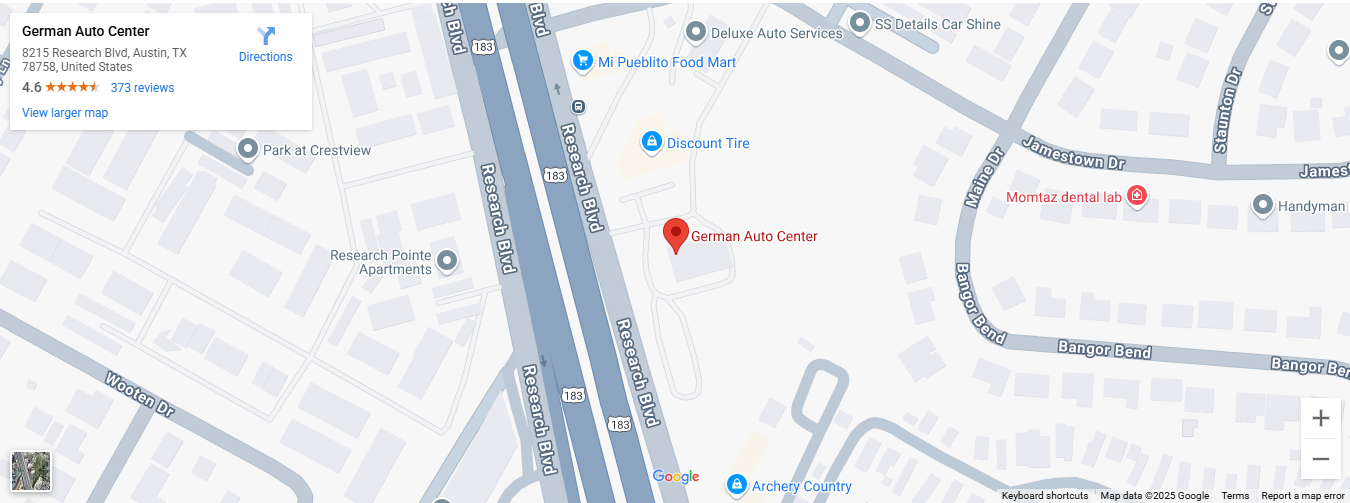
Yes. We service all 2018 and newer Porsche Macan models including the base 2.0T, Macan S, GTS, and Turbo. We are a Bosch Authorized Service Center with PIWIS-compatible diagnostic equipment and over 45 years of Porsche experience in Austin. Our shop is at 8215 Research Blvd. Call (512) 452-6437 or schedule online.
If you own a 2018 or newer Porsche Macan in Austin and want a shop that knows these cars, give us a call at (512) 452-6437 or schedule online. Bring it by 8215 Research Blvd and we’ll give you a straight assessment of where it stands and what it needs. No pressure, no upsell.