That amber warning light just came on during your morning commute on MoPac. Or you noticed a faint burning smell after parking in the heat. Or your C-Class is idling slightly rougher than it did three months ago and you’ve been telling yourself it’s nothing. Maybe it is nothing. Maybe it isn’t.
At German Auto Center, we’ve been diagnosing and repairing Mercedes-Benz vehicles in Austin since 1979. In that time we’ve learned which warning signs Mercedes owners can safely monitor for a few days and which ones demand attention before the next drive. This guide covers both, so you’re not guessing when something comes up.
Perry Carrison, a Mercedes E300 owner who found us after visiting four other shops in Austin, put it simply about our approach: “They are all 100% authentic, skilled and friendly.” That’s the standard we hold ourselves to on every diagnosis we perform. You deserve a straight answer, not a parts cannon and a large invoice.
Why Mercedes-Benz Warning Signs Deserve More Attention Than Most
A warning light on a Toyota and a warning light on a Mercedes-Benz are not the same conversation. Mercedes vehicles carry more complex electronics, more sophisticated subsystems, and more expensive components than most cars on the road. A symptom that turns out to be minor on a simpler vehicle can point to a serious underlying issue on a Mercedes, particularly on models with AIRMATIC air suspension, 4MATIC all-wheel drive, or the AMG performance variants.
The other factor is diagnostic equipment. Mercedes uses its own XENTRY and DAS software architecture, and reading fault codes properly on a W205 C-Class or a W213 E-Class requires manufacturer-compatible tools. A generic OBDII scanner pulls basic codes. It does not surface the manufacturer-specific faults stored in the various control modules that govern transmission behavior, suspension calibration, and engine management on a modern Mercedes. If a shop tells you they diagnosed your Mercedes with a standard scanner, get a second opinion.
We use Mercedes-compatible diagnostic equipment on every car that comes in. The difference in what gets surfaced is significant, and it directly affects the accuracy of the repair recommendation.
The Check Engine Light on a Mercedes-Benz: What It Usually Means
Should I keep driving with a check engine light on?
It depends on what else is happening. A steady check engine light with no other symptoms and normal driving behavior is generally safe for a short period, but should be diagnosed within a few days. A flashing check engine light is a different situation entirely. On a Mercedes, a flashing CEL indicates an active misfire. That means one or more cylinders are not completing combustion properly, and continuing to drive hard will damage the catalytic converters, which are expensive to replace on a Mercedes.
The most common causes of a check engine light on C-Class, E-Class, and GLE models are oxygen sensor faults, mass airflow sensor contamination, spark plug and coil pack wear, and on older examples, issues with the crankcase ventilation system. On the M274 four-cylinder and M276 V6 engines found in many Austin Mercedes, we also see balance shaft gear wear triggering fault codes on higher-mileage cars. That one requires more than a code reset to address properly.
The worst thing you can do with a Mercedes check engine light is ignore it, clear the code without diagnosing the cause, or have it read at a parts store and replace whatever part the generic code points to without confirming the actual fault. We see the consequences of all three approaches regularly.
Oil Leaks and Burning Smell: Where Mercedes-Benz Engines Typically Leak
What causes oil leaks on a Mercedes-Benz?
Oil leaks on Mercedes vehicles follow predictable patterns based on model and mileage. Knowing where to look tells you a lot about severity before you even get under the car.
The valve cover gasket is one of the most common leak points on M271, M274, and M276 engines. Oil seeping from the valve cover migrates down the back of the engine and, on some configurations, finds its way onto the exhaust manifold. That’s where the burning smell comes from after a drive. The repair is moderate in cost and straightforward when caught early. Left alone, the oil contamination can reach ignition coils and cause misfires on top of the leak itself.
The oil filter housing gasket is another high-frequency leak on these engines. The housing sits in a position where small seeps coat the underside of the engine over time, making it look worse than it is. But slow leaks become fast leaks, and any oil reaching the serpentine belt or accessory drive components creates a much larger repair bill.
On the OM642 diesel V6 found in the ML350 Bluetec and E350d, we also watch carefully for oil separator and swirl flap issues. These are specific to the diesel engine architecture and require a technician familiar with Mercedes diesel systems to diagnose and address properly. If you own a diesel Mercedes and are seeing increased oil consumption or a rough cold start, bring it in before assuming the problem will stabilize on its own.
Transmission Behavior That Should Not Be Ignored
What does a rough shifting Mercedes transmission mean?
Mercedes transmission issues are one of the more expensive repairs we perform, and they are almost always more expensive when they have been ignored for a while. The 7G-Tronic automatic transmission found across the C-Class, E-Class, GLE, and other Mercedes models is a sophisticated unit that performs exceptionally well when maintained and shows wear patterns that escalate quickly when it isn’t.
The conductor plate inside the 7G-Tronic is a known failure point, particularly on higher-mileage examples and cars that have run extended transmission fluid intervals. The conductor plate manages solenoid control for gear selection, and when it wears, the symptoms show up as erratic shifting, hesitation between gears, and fault codes that can be mistaken for an electrical issue rather than a mechanical one.
Early warning signs of a transmission that needs attention include a slight shudder during gentle acceleration from a stop, a momentary hesitation when selecting Drive or Reverse from Park, and shift quality that has gradually become less smooth over time without a single obvious event triggering it. These symptoms rarely resolve on their own. A fluid exchange at the right mileage interval catches conductor plate wear early and extends the transmission’s life considerably.
A longtime Mercedes owner who has been bringing her car to us told us plainly that we have “never taken advantage” of her in all the years she’s been a customer. That’s the approach we take on every transmission diagnosis. We tell you what we find, what it means, and what it will cost. Nothing more.
AIRMATIC Air Suspension Warnings: Take These Seriously
Is it safe to drive a Mercedes with an AIRMATIC warning?
No. An AIRMATIC warning on a Mercedes-Benz should be treated as an urgent fault, not a monitor-and-wait situation. The AIRMATIC system controls ride height and suspension stiffness electronically using air struts and a compressor. When the system detects a fault, it typically defaults to a lower ride height or a firmer suspension mode to protect the components. Driving in AIRMATIC fault mode puts additional stress on the struts, the compressor, and the related components.
The most common AIRMATIC failures we see on E-Class, S-Class, GLE, and GL models are air strut leaks, compressor wear from running continuously to compensate for a slow leak, and ride height sensor faults. An air strut that’s losing pressure slowly will show up as the car sitting lower on one corner after an overnight park. The compressor running longer than usual is the system fighting to maintain ride height against the leak.
Catching an AIRMATIC strut leak early means replacing one strut at a reasonable cost. Ignoring it means the compressor eventually fails from overwork, adding compressor replacement on top of the strut. We have seen this progression play out more times than we can count, and the cost difference between catching it early and catching it late is significant.
Damon Osgood, who has been a customer for years, described us as “the kind of place you build a long term relationship with” because we give honest assessments and tell customers what actually needs attention versus what can wait. An AIRMATIC warning is one that does not wait.
Coolant Warnings and Temperature Gauge Changes: Do Not Drive Through These
What should I do if my Mercedes overheats?
Pull over as soon as it is safe to do so. An overheating Mercedes engine, particularly the M272 or M276 V6, can suffer head gasket damage or warped cylinder heads within a short distance of the temperature climbing into the red. The repair bill for heat damage starts at several thousand dollars and climbs from there. The repair bill for whatever caused the overheating in the first place is almost always a fraction of that.
Common cooling system failure points on C-Class, E-Class, and GLE models include the thermostat, the water pump, and the expansion tank. The plastic expansion tank is a particular concern on higher-mileage examples. Small cracks develop over time and cause slow coolant loss that’s easy to miss until the low coolant warning triggers or the temperature gauge starts moving. A pressure test of the cooling system surfaces these leaks before they become emergencies.
Austin’s heat accelerates cooling system wear faster than most Mercedes owners realize. A thermostat that’s beginning to stick in a cooler climate will fail faster here. We recommend having the coolant tested and the cooling system pressure-checked every three years on any Mercedes driven in Central Texas, regardless of mileage.
Electrical Faults and Multiple Warning Lights at Once
Why does my Mercedes have multiple warning lights on at the same time?
Multiple warning lights appearing simultaneously on a Mercedes is almost always a sign of one underlying fault that has cascaded across several systems rather than multiple independent problems. The Mercedes electronics architecture is deeply interconnected. When a voltage issue, a failing battery, or a control module fault appears, it triggers faults across other systems that share the same network. The result looks catastrophic on the dash. It usually isn’t.
The 12-volt battery is the most common single cause of multi-system warning light events on Mercedes vehicles. A battery that’s weakening but not yet dead can produce unstable voltage that triggers faults in the transmission control unit, the suspension management system, the ESP, and other modules simultaneously. Replacing the battery and clearing the codes resolves all of them at once. The complication is that Mercedes requires battery registration when a new battery is fitted, a process that requires manufacturer-compatible software and is skipped by shops without the right tools.
The wiring harness is a longer-term concern on any Mercedes that has spent significant time in Austin’s heat. Prolonged UV and heat exposure can cause insulation to harden and crack, leading to intermittent electrical faults that are frustrating to trace without proper diagnostic equipment. If your Mercedes is showing electrical gremlins that come and go without a consistent pattern, a wiring harness inspection is worth including in the next service visit.
A Practical Guide to Which Warnings Can Wait and Which Cannot
Not every Mercedes warning sign demands same-day attention. Here is a straightforward breakdown based on what we see in the shop.
Address immediately, do not drive further: Temperature gauge in the red or climbing above normal, AIRMATIC fault with the car sitting low on a corner, oil pressure warning light, any warning accompanied by smoke, burning smell from the engine bay, or unusual mechanical noise.
Schedule within 24 to 48 hours: Flashing check engine light, transmission fault message, coolant level warning, multiple warning lights appearing together, any warning accompanied by a change in driving behavior.
Schedule within the week: Steady check engine light with no other symptoms, minor oil seep with no burning smell, slight shift hesitation that appeared recently, brake wear indicator light.
When in doubt: Call us at (512) 452-6437. A two-minute conversation usually tells you which category you’re in.
Why Austin Mercedes Owners Choose Independent Service Over the Dealership
Mercedes-Benz dealership labor rates in Austin are among the highest in the market. For diagnosis and repair on a car you’ve already paid a premium to own, the cost at the dealership can feel like a second purchase. Owners who bring their cars to an independent Mercedes shop in Austin with the right credentials and equipment consistently find the same quality of work at significantly lower cost.
Perry Carrison visited four shops before bringing his E300 to us. None of them had time to speak with him. Our team walked out to his car in the parking lot. He’s been a customer ever since, and told us recently that even when we missed a deadline on his car, the response was a sincere apology and the car delivered on time. His words: “That’s what real people do.”
What makes independent service work on a Mercedes is not just the cost. It’s the relationship. The dealership sees hundreds of cars a week. An independent shop that specializes in German vehicles knows your car, knows its history, and gives you the kind of communication you’d expect from someone who actually cares whether the repair was done right.
We are a Bosch Authorized Service Center with over 45 years of Mercedes-Benz experience in Austin. We use XENTRY-compatible diagnostic equipment, OEM-quality components, and ASE-certified technicians on every car we touch.
Frequently Asked Questions
What are the most common Mercedes-Benz problems in Austin?
+
The most common issues we see on Austin Mercedes vehicles are check engine lights related to oxygen sensors, MAF sensor contamination, and coil pack wear. Oil leaks from the valve cover gasket and oil filter housing are frequent on M274 and M276 engines. Transmission conductor plate wear on 7G-Tronic equipped cars, AIRMATIC air strut leaks, cooling system failures from thermostat and expansion tank wear, and 12-volt battery faults triggering multi-system warning events are all patterns we diagnose regularly.
Is it safe to drive my Mercedes with the check engine light on?
+
A steady check engine light with normal driving behavior is generally safe for a short period but should be diagnosed within a few days. A flashing check engine light indicates an active misfire and the car should not be driven hard until it is diagnosed. Any check engine light accompanied by unusual noise, a temperature change, or a driving behavior change should be addressed immediately.
How much does Mercedes-Benz repair cost at an independent shop versus the dealership in Austin?+
Independent shop rates in Austin run 30 to 40 percent lower than Mercedes dealership rates for comparable work. On major repairs like AIRMATIC strut replacement, transmission service, or cooling system work, the savings are meaningful. German Auto Center is a Bosch Authorized Service Center, which means the quality of parts and diagnostic equipment matches what you receive at the dealership.
What causes the AIRMATIC warning light on a Mercedes?+
The most common AIRMATIC fault causes are air strut leaks, a failing compressor, and ride height sensor errors. A strut leak typically presents as the car sitting lower on one corner after an overnight park. The compressor running continuously or for longer than usual is the system compensating for pressure loss. AIRMATIC warnings should be addressed promptly since delaying a strut repair often leads to compressor failure and a significantly larger repair bill.
Does German Auto Center offer Mercedes Repair in Austin for all models?+
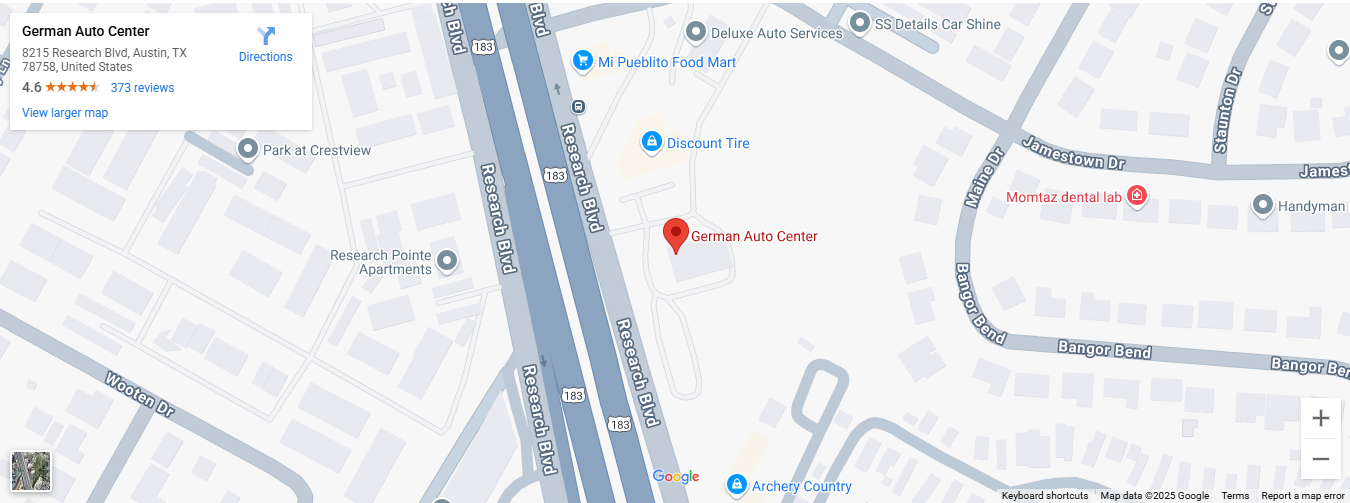
Yes. We service the full Mercedes-Benz lineup including C-Class, E-Class, S-Class, GLE, GLC, GLS, G-Class, and AMG variants. We use XENTRY-compatible diagnostic equipment and Bosch-supplied OEM components. Our shop is at 8215 Research Blvd in Austin. Call (512) 452-6437 or schedule online at germanautocenter.com.
How do I know if my Mercedes needs a transmission service?+
Early signs of a Mercedes transmission that needs service include a slight shudder during gentle acceleration from a stop, hesitation when selecting Drive or Reverse from Park, and a gradual softening of shift quality over time. These symptoms rarely present suddenly and often develop over thousands of miles. A transmission fluid exchange at 40,000 to 60,000 miles on 7G-Tronic equipped cars is the most effective preventive measure.
If your Mercedes-Benz is showing any of the warning signs above and you want a straight answer on what is actually happening, give us a call at (512) 452-6437 or schedule online. Bring it to 8215 Research Blvd in Austin and we will run a proper diagnostic, tell you exactly what we find, and give you an honest picture of what it needs and what can wait. No pressure, no guesswork.