You’re pulling into Cedar Park Costco (located at 2801 E Whitestone Blvd, Austin, TX), barely touching the brake pedal, and your car sounds like a screaming teakettle. Embarrassing? Yeah. Dangerous? Maybe not.
Here’s the thing about brake squealing: most people think it means something’s about to fall off the car. Sometimes they’re right. But a lot of the time? It’s just physics being annoying.
We see probably 10-15 cars a week where someone comes in panicked about squealing brakes, and half the time there’s nothing actually wrong. The other half? Well, that’s a different story. Let me break down what’s actually happening under there so you know when to ignore it and when to get it checked.
What’s Actually Making That Noise
When your brakes squeal, it’s because of something engineers call the “stick-slip phenomenon.” strange name, but it describes exactly what’s going on.
Your brake pads are pressing against the rotors, right? They’re not sliding smoothly—they’re doing this rapid stick-and-release thing, like when you drag a wet finger across a window. Stick, slip, stick, slip, hundreds of times per second. That creates vibrations, and those vibrations get amplified by the rotor, which is basically a big metal disc acting like a speaker.
The friction between the pads and rotors goes through phases. Static friction when they stick, kinetic friction when they slip. Back and forth. The rougher the surfaces are, the more friction you get, and the louder the noise.
And here’s why it’s worse at slow speeds: when you’re barely moving, the stick phase lasts longer. More stick time means bigger vibrations, which means more noise. That’s why your brakes might be dead silent at 60 mph on Mopac but sound like a dying cat when you’re creeping through the Chick-fil-A drive-through.
Bigger brakes make more noise too. If you’ve got an Audi with those massive rotors, you’ve got more surface area creating friction. More friction, more opportunity for squealing.
At German Auto Center, we are proud to be the most trusted and reliable certified luxury auto mechanic shop in Austin Texas. Our customers appreciate our honest and reliable diagnosis and repairs.
★★★★★
Uriel Gallardo
“Got my brake pads and rotors replaced here along with a full brake fluid flush, and the whole experience was smooth from start to finish. The team at German Auto Center is fast, honest, and really knows their stuff. They walked me through everything, kept me updated, and the car drives like new again. Pricing was fair, service was professional, and the quality speaks for itself. Definitely my go-to spot for anything German car related. Highly recommend!”
When Squealing Is Just Annoying (Not Dangerous)
Squealing breaks don’t automatically mean something’s broken. We’ve had customers come in absolutely convinced they need new brakes, and we put it on the lift and the pads still have 7mm of material left. Totally fine.
Brake squealing can happen because of:
Weather and humidity – Austin, TX random weather does weird things to brakes. You park outside during one of our surprise rainstorms, moisture gets on the rotors, you get surface rust overnight, and boom—squealing the next morning. Usually goes away after a few stops once the rust wears off.
Temperature changes – When it’s 95 degrees at 3pm and then drops to 65 by 7pm (because Texas), your brake components expand and contract at different rates. Different materials, different expansion rates, temporary squealing.
Brake dust and debris – Construction dust from all the building going on around the Domain, pollen from cedar season, road grit—all that stuff gets between your pads and rotors and causes noise. Not a problem, just irritating.
New brakes breaking in – If you just got new pads installed, they’re going to make noise for the first 100-200 miles. The surface of new pads is perfectly smooth, and it takes some time for them to mate properly with the rotors. Totally normal.
The brake system has multiple moving parts, and each one vibrates at its own frequency. When all those frequencies couple together, you get complex vibrations that sound like squealing. It’s not always a sign of wear—sometimes it’s just how the physics work out on that particular day.
When Breaks Squealing Means You Need to Get It Checked
Now, here’s when you should actually worry.
If the squealing is accompanied by:
– Grinding (sounds like metal-on-metal) – This means you’re probably down to the backing plate. You’ve worn through the pad completely and now you’re destroying your rotors. Not cheap to fix.
– Pulsing in the brake pedal – Warped rotors. Common on German cars if you do a lot of hard braking or live somewhere hilly (looking at you, West Lake Hills).
– Pulling to one side – Could be a stuck caliper or uneven pad wear. Safety issue.
– Brake warning light – Some cars have a wear indicator built into the pad. When that light comes on, you’re done. Time for new brakes.
We had a woman come in last month for a Mercedes Repair in Austin, TX. Her E300 Mercedes had been squealing for “a few weeks.” By the time she brought it in, she’d worn through both front pads completely and scored the rotors so badly they couldn’t be resurfaced. What should’ve been a $450 brake service turned into $900 because she waited. The rotors alone were $300 more than they should’ve cost. Don’t be that person. If your German car (BMW, Mercedes, Audi, VW, Land Rover, Porsche & Mini) is making a squealing sound, you can trust our ASE certified mechanics for an honest and reliable diagnosis. As one of the most trusted and experienced German auto mechanic shop in Austin, TX, we have been serving customers for over 45 year and are happy to share how our customers feel about our service.
★★★★★
Chris and Lynn!
“Own a German made car? Stop wasting your time and money elsewhere. Another shop said I needed a 4k brake job. German Auto Center showed me that not only did I not need a brake job, but that my brakes were perfectly fine. I will never take ‘Jessica’ anywhere else. Period! Thank you “ Why Your Mechanic Can’t Predict Every Squeal
There’s no way to predict every single scenario that might cause brake squealing. Every car is different, every driver is different, every environment is different. We can engineer brake systems to handle a wide range of temperatures and conditions. We can add dampening materials to reduce vibrations. We can use high-quality pads designed to minimize noise. But at the end of the day, you’re driving through wildly variable conditions—105-degree heat one day, flash floods the next, cedar pollen coating everything in between.
The stick-slip phenomenon is influenced by temperature, moisture, humidity, wear patterns, and corrosion. You can’t control all those variables. Some brake squealing is just going to happen, no matter how good your brakes are.
That said, if it’s constant, if it’s getting worse, or if it’s accompanied by any of the warning signs I mentioned above? Get it checked. Better to spend $100 on an inspection and find out it’s nothing than to ignore it and end up with a $1,500 brake job because you destroyed the rotors. Bring it for a diagnosis and experience the German Auto Center difference like Clarence below:
★★★★★
Clarence Jones
*”Good place of business I recommend any German or foreign car this is the place. I talk to Brant and he took care of everything good person in must add. It wasn’t no hassle or nothing being overpriced as the dealer would cost way more. All in all great place thanks German Auto”
What We Actually Check When You Come In
When someone brings a car in for squealing brakes, here’s what we do:
- Listen to it – We’ll take it for a quick drive around the block to hear exactly what you’re hearing
- Measure pad thickness – If you’re below 3mm, you need new pads soon. Below 2mm, you need them now.
- Check the rotors – Looking for scoring, warping, uneven wear
- Inspect the calipers – Make sure they’re moving freely and not sticking
- Look at the brake fluid – Old, contaminated fluid can cause issues
- Check for debris – Sometimes it’s literally just a pebble stuck in there
If everything checks out and your pads are still thick, we’ll tell you it’s just normal squealing and you’re fine. No charge for the inspection if you’re a regular customer. If something actually needs fixing, we’ll show you exactly what’s wrong and what it’ll cost before we touch anything.
We’re not going to tell you that you need a $2,000 brake service when all you need is to drive it for another week and let the surface rust wear off. We’ve been doing
Luxury Auto Repair Austin, TX work since 1979—our reputation matters more than one unnecessary brake repair. You don’t have believe us, just listen to what our customers say about us.
★★★★★
Maureen Nodland
“Exceptional customer service, fair and honest staff, and unbeatable pricing on service.”
Bottom Line
Squealing brakes are annoying, but they’re not always a sign that something’s wrong. Physics is weird, and sometimes your brakes just make noise.
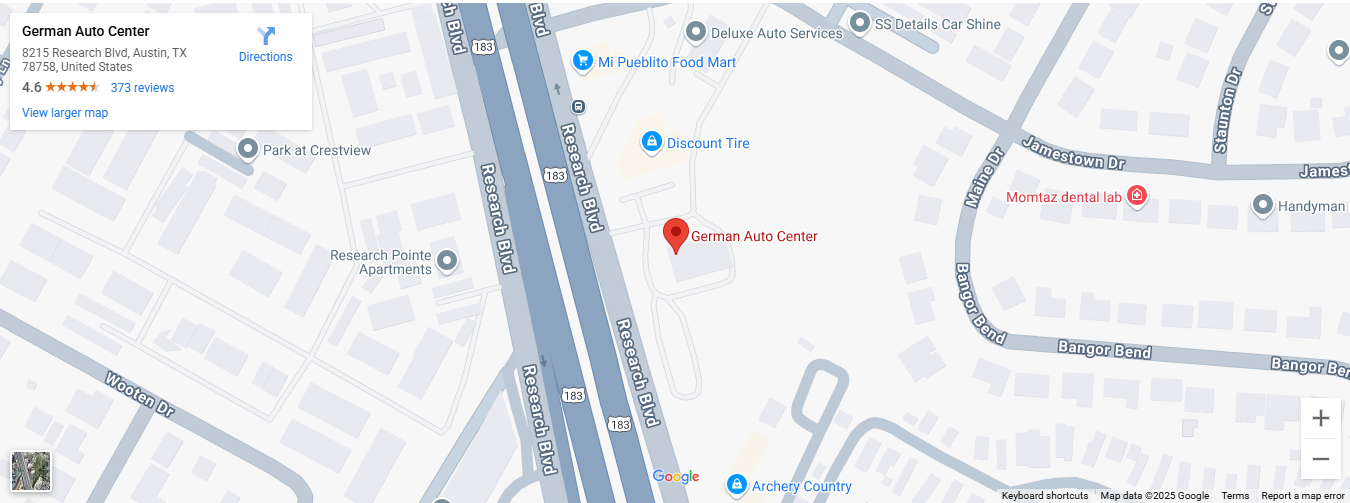
But if you’re hearing grinding, feeling pulsing, or seeing a warning light? Don’t mess around. Come by the shop at 8215 Research Blvd or give us a call at (512) 452-6437. We’ll figure out if it’s something that needs fixing or just the stick-slip phenomenon doing its thing.
And if you need actual brake repair Austin work? We’ll do it right, we’ll do it for way less than the dealership, and we’ll actually explain what we’re doing instead of just handing you a $3,000 bill. That’s how we’ve stayed in business for 45 years.